
KEMETIC MINDS
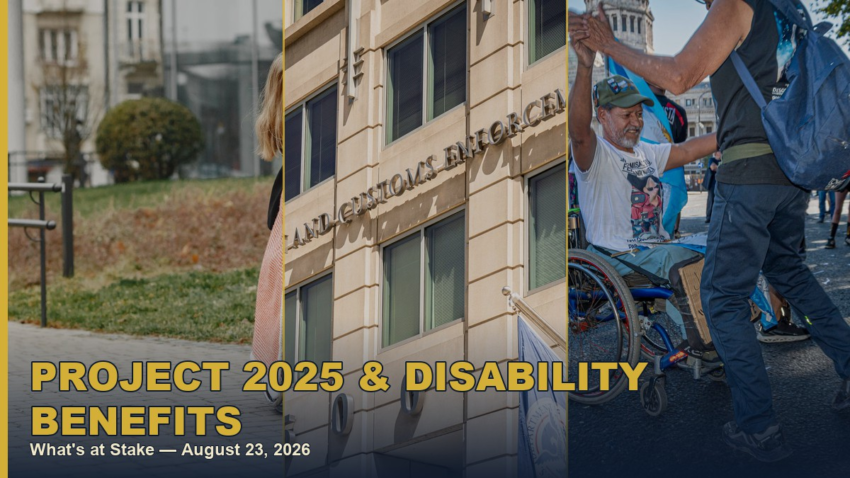
Project 2025 & Disability Benefits — August 23, 2026
A ProPublica investigation published today reveals the Trump administration is quietly advancing a rule that would cut or eliminate Supplemental Security Income for up to 400,000 disabled Americans who live with family [1]. The change would strip benefits from some of the poorest SSI recipients — including adults with intellectual disabilities and the low-income parents who house them — for the simple fact of sharing a roof [1]. It is moving forward as the architect of Project 2025 says the president has turned just over half of the blueprint into reality [2].
- Up to 400,000 people affected. As many as 400,000 poor and disabled people could have their SSI support cut or eliminated, according to a ProPublica analysis of Social Security Administration actuarial figures [1].
- A bedroom would count against recipients. The rule would deduct the value of a disabled adult’s bedroom from their SSI allotment even when the household is poor enough to qualify for food stamps — cutting benefits by up to a third, or about $330 a month [1].
- White House and DOGE are driving it. The effort was initiated by top White House and Department of Government Efficiency officials last year, multiple Social Security officials said [1].
- Second attempt. Budget Director Russell Vought and Social Security Commissioner Frank Bisignano abandoned a different disability-regulation proposal last year after news reports detailed the harm it would cause [1].
- Project 2025 overlap. The 2027 budget overseen by Vought — himself a Project 2025 architect — is filled with proposals that appear copied from the Heritage Foundation blueprint [3].
- Disabled workers fall through cracks. SSDI has no minimum claiming age, but Social Security retirement benefits generally cannot begin before 62 — leaving workers whose bodies fail early with no paycheck and no retirement check [4].
“Even a glance at Shy’tyra Burton’s life reveals her need for the sort of federal government assistance that helps disabled Americans stay in their homes.”
ProPublica — Read the full report →
What’s Happening Right Now
The rule would undo a long-standing federal policy, updated during the Biden administration, under which a household that has already demonstrated its poverty through SNAP or other public assistance programs is officially deemed unable to financially support a disabled loved one living at home [1]. Under the new approach, it would not matter if SNAP had already determined a family was poor enough to receive aid: anyone living at home beyond age 18 without paying full rent would be treated as if they have a benefactor [1].
The human stakes are visible in the case of Shy’tyra Burton, a 22-year-old Philadelphian. Born two months prematurely into a poor family, unable to breathe or swallow without tubes, and largely confined to medical facilities until age 4, Burton was diagnosed with developmental and intellectual disabilities that left her IQ below 70 [1]. She graduated from a high school special education program and attempted community college, but could not get hired — including at McDonald’s. Only after multiple medical and psychological evaluations and a hearing before a judge did the federal government approve her for SSI [1].
Burton’s $994 monthly benefit is lifesaving but not enough to support her on her own, so she lives with her father, a Philadelphia sanitation worker who earns about $2,000 a month. The pending rule would deduct the value of her bedroom from her allotment, cutting her check by about $330 a month — or ending her support altogether [1].
The change was initiated by top White House and Department of Government Efficiency officials last year, multiple Social Security officials said. It marks a second attempt by the administration to quietly downsize disability programs overseen by the Social Security Administration, despite their strict eligibility standards and minimal instances of fraud [1]. Vought and Bisignano abandoned a different proposed regulation last year after ProPublica and other outlets reported the harm it would cause to hundreds of thousands of largely blue-collar workers in red states [1].
The disability programs are administered by the Social Security Administration but are separate from the retirement program, which the administration has promised not to cut [1].
The impact would concentrate in households already at the economic edge. The typical SNAP household supporting an SSI recipient has an annual total income of just $17,000, according to the nonpartisan Center on Budget and Policy Priorities [1]. Those affected include younger adults with Down syndrome and severe autism living at home with low-income parents, as well as older people with health or financial problems who have moved in with adult children [1].
Opposition is forming across ideological lines. Galen Carey, vice president of government relations for the National Association of Evangelicals and father of a 35-year-old son with Down syndrome who lives at home and receives SSI, said protecting the program is “about how the faithful will be judged, and our care for the most vulnerable” [1]. “Knowing that they are contributing and not a burden to the family can be a source of great pride,” he said — and about 40 Down syndrome organizations recently sent a letter to Bisignano opposing the planned change [1].
The broader disability safety net is already straining for workers who break down before retirement age. SSDI has no minimum claiming age and pays a full benefit, while claiming Social Security retirement at 62 permanently cuts monthly payments by up to 30% [4]. A successful SSDI claim requires proving inability to perform not just a previous job but any job, backed by thorough medical documentation [4].
Consider the scenario described by 247Wallst: a heavy equipment operator who earned six figures with overtime and, at 61, can no longer climb into the cab or tolerate ten hours in the seat. Social Security retirement’s earliest starting age is 62, leaving him with no paycheck and no retirement check for another year [4].
What Project 2025 Actually Proposes
Project 2025 is the Heritage Foundation’s 920-page governing blueprint, “Mandate for Leadership: The Conservative Promise,” published in April 2023 to little fanfare (Poynter, 2025). By fall 2024, Democrats were doing everything they could to tie Trump to the document; Trump denied any knowledge of it, then signed several executive orders implementing its proposals on his first day in office (Poynter, 2025).
The implementation record is substantial. As of mid-December 2025, trackers run by various progressive groups suggested Trump had achieved roughly half of Project 2025’s goals (Poynter, 2025). The plan’s architect, Heritage Foundation President Kevin Roberts, told C-SPAN that Heritage has presented such “presidential transition projects” since 1980 and that the president deserves credit for implementing just over half of the proposals: “The person who deserves credit for that is one Donald J. Trump” [2].
The blueprint’s footprint is visible in the administration’s 2027 budget. The proposed budget from the Office of Management and Budget is “filled with ideas that appear to be copied and pasted from Project 2025’s Mandate for Leadership,” according to Media Matters [3]. Its overseer, Russell Vought, was an architect of the initiative and its signature publication before becoming budget director [3].
The document uses the word “woke” more than 30 times and proposes defunding programs such as Commerce Department initiatives “focused on woke and meaningless initiatives,” including support for LGBTQ businesses [3]. In places it outruns the blueprint: Project 2025 concedes Congress is unlikely to defund the Minority Business Development Agency and suggests leveraging it instead, while the 2027 budget proposes defunding the agency entirely [3].
In his forward to the Mandate for Leadership, Roberts calls for making “the institutions of American civil society hard targets for woke culture warriors” — in part by deleting terms including SOGI, DEI, gender, gender equality, abortion, and reproductive health, along with “any other term used to deprive Americans of their First Amendment rights,” from every federal rule, regulation, contract, and piece of legislation that exists [3].
Its media agenda has become reality. The first sentence of Project 2025’s section on public broadcasting calls for defunding NPR and PBS, and this year Trump became the first president to actually carry it out — trying in April to fire three board members of the Corporation for Public Broadcasting, then issuing an executive order instructing it to stop funding NPR and PBS, with both actions challenged in court (Poynter, 2025).
What’s Disputed or Unconfirmed
The SSI change is a proposed rule, not a finished one. ProPublica’s reporting is based on four federal officials, internal emails, and a federal regulatory listing, and describes the administration as “working on” the change and “poised” to adopt it [1].
The administration has already abandoned one disability cut under public pressure. Vought and Bisignano scrapped a different proposed regulation last year after ProPublica and other outlets reported the harm it would cause, so whether this plan survives is unconfirmed [1].
The 400,000-person figure is ProPublica’s own analysis of Social Security Administration actuarial figures, not an official SSA estimate [1].
Claims about Project 2025’s implementation rate come from the plan’s architect and from trackers run by progressive advocacy groups, not from independent government audits (Yahoo, 2026; Poynter, 2025).
Media Matters’ description of the 2027 budget as “copied and pasted” from Project 2025 is a watchdog’s characterization of apparent parallels, not an official administration acknowledgment [3].
Notably, none of the sources documenting Project 2025’s contents quote a specific SSI or SSDI proposal from the Mandate for Leadership. The connection between the blueprint and the disability cuts is structural — personnel such as Vought, the budget’s apparent borrowings, and the plan’s overall implementation record — rather than a verified disability provision lifted directly from the document [3][1].
The story of the 61-year-old heavy equipment operator is an illustrative scenario from a financial news explainer — introduced by the article as “Picture a man…” — not a named individual’s case record [4].
Your Options If You Could Be Impacted
If you or a family member receive SSDI or SSI, here is where to go for real help — not speculation.
- Check your own status directly with SSA. Create or log in to a my Social Security account to see your current benefit, any pending reviews, or overpayment notices straight from the source[5].
- Got an overpayment notice? You can request a waiver or appeal, and ask for a lower repayment rate, before money is withheld — SSA’s own overpayments page explains the request process and deadlines[6].
- Free legal help exists specifically for this. Every state has a federally funded Protection & Advocacy agency that provides free help to people with disabilities on benefits issues — find yours through the National Disability Rights Network[7].
- Disability benefits attorneys often work on contingency (no fee unless you win), and NOSSCR’s directory can help you find one who specializes in Social Security disability appeals[8].
- Broader free legal aid for benefits, housing, or family issues tied to a loss of income is searchable by state at LawHelp.org[9].
- Immediate local assistance — food, utilities, emergency funds — is available by dialing 211 or searching 211.org[10].
Disclosure: Kemetic Minds is a news and information site, not a law firm or financial advisory service. Nothing in this article is financial, legal, or benefits advice, and reading it does not create any advisory or attorney-client relationship. Every situation is different — for a decision about your specific benefits, income, or overpayment notice, contact SSA directly or one of the free/qualified professionals linked above.
SUPPORT KEMETIC MINDS
Enjoying this coverage? Back the work and find every way to connect with us in one place.
Support the Page →References
- ProPublica. (2026, August 23). Trump Administration Push to Cut Social Security, SSI Disability Benefits for Parents and Children. https://www.propublica.org/article/trump-social-security-ssi-disability-benefits-cuts-parents-children ↩a ↩b ↩c ↩d ↩e ↩f ↩g ↩h ↩i ↩j ↩k ↩l ↩m ↩n ↩o ↩p ↩q ↩r ↩s ↩t ↩u ↩v
- Yahoo. (2026, June 1). Project 2025 Has Largely Become A Reality As Plan’s Architect Thanks Trump For Implementing Most Proposals. https://www.yahoo.com/news/politics/articles/project-2025-largely-become-reality-013427711.html ↩a ↩b
- Mediamatters. (2026, April 14). Dozens of Project 2025 proposals appear to be included in the Trump administration's newest budget. https://www.mediamatters.org/project-2025/dozens-project-2025-proposals-appear-be-included-trump-administrations-newest-budget ↩a ↩b ↩c ↩d ↩e ↩f ↩g ↩h
- 247Wallst. (2026, August 21). He Earned Six Figures Running Heavy Equipment. At 61, His Body Retired Before Social Security Would Let Him.. https://247wallst.com/personal-finance/social-security/2026/08/21/he-earned-six-figures-running-heavy-equipment-at-61-his-body-retired-before-social-security-would-let-him/ ↩a ↩b ↩c ↩d ↩e
- Social Security Administration. Disability Benefits. ↩
- Social Security Administration. Overpayments. ↩
- National Disability Rights Network. Find Your Protection & Advocacy Agency. ↩
- National Organization of Social Security Claimants’ Representatives. Find a Representative. ↩
- LawHelp.org. Find Free Legal Aid. ↩
- 211.org. Find Local Assistance. ↩
Reporting Methodology: This report is grounded in ProPublica’s original investigation plus additional live news sources. Every factual claim is tied to fetched source text with a numbered footnote citation; nothing is written from the model’s general knowledge, and no Project 2025 language is invented — only what the cited sources report it says. Any video embed is verified to be a real, existing video via YouTube’s oEmbed endpoint and restricted to a credible-outlet allowlist before publication. Pull-quotes are extracted verbatim from the cited article, never composed. The “Options If You’re Impacted” section is static, hand-written guidance sourced directly to SSA.gov and established legal-aid/advocacy organizations, never generated by the drafting model, and is not financial, legal, or benefits advice.
Stay Connected

Kemetic Minds Editorial Desk
Verified NewsroomPrimary-sourced investigative intelligence on civil rights, voting rights, federal policy, and consumer protection. Sourced from primary legal filings, government statistics, and direct field reporting.