
KEMETIC MINDS
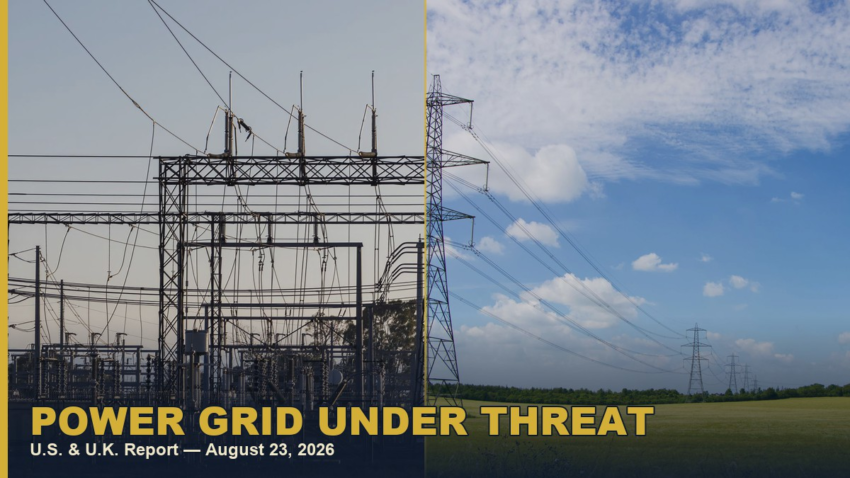
Power Grid Under Threat — U.S. & U.K. Report — August 23, 2026
Two power-grid alarms hit the United States and United Kingdom this week: U.S. officials are reviving warnings that a handful of substations could black out the nation for 18 months, while U.K. authorities are responding to an Iranian-linked cyberattack that took a British power generator offline for four days.
Key Takeaways
- A 2013 FERC analysis concluded that disabling just nine key substations could paralyze the entire American grid for 18 months [1].
- Storm damage in Indiana left more than 75,000 people without power for over a week; thousands in Gary remained dark for more than two weeks [1].
- Iran-linked hackers were blamed for a cyberattack that shut down a small-scale UK power generator for four days [2].
- The Telegraph reported the incident was the first successful strike of its kind on vital British infrastructure, though the government says the national grid was not endangered [3].
- UK officials assessed the attack was likely a demonstration of Iranian access rather than an attempt to harm civilians [4].
- The unsolved 2013 Metcalf substation shooting is again fueling warnings that the U.S. grid remains vulnerable [5].
1. United States: The Nine-Substation Warning
Federal energy experts warn that the U.S. electricity network is so fragile that a coordinated attack could leave the country without power for up to 18 months [1].
A 2013 internal power-flow analysis by the Federal Energy Regulatory Commission (FERC) concluded that disabling just nine key substations could paralyze the entire American grid for 18 months [1].
Jon Wellinghoff, former chairman of FERC, revealed that the 2013 Metcalf substation attack triggered critical internal analyses [1].
In 2013, snipers shot up 17 electrical transformers at the Metcalf substation near San Jose, California; that localized attack took 27 days to repair even while the surrounding grid stayed operational [1].
A dozen years later, the attack remains unsolved and is once again fueling warnings that the nation’s power grid remains exposed [5].
This year’s real-world test came from weather, not attackers. On August 11, storms with 99 to 130 mph winds tore across Indiana, initially knocking out power for 300,000 customers [1].
More than 75,000 people were without power for more than a week, and thousands of residents in Gary were left without power for more than two weeks [1].
Crews had to rebuild the local network from scratch, replacing 300 utility poles and 44 heavy transmission structures [1].
“Power Grid Faces Blackout Warning as One City Goes Dark for Over a Week A prolonged blackout in an Indiana city is shining a bright light on America's aging power grid and revealing major national vulnerabilities.”
Yahoo — Read the full report →
2. United Kingdom: Iran-Linked Hackers Blamed for a Four-Day Plant Shutdown
Hackers linked to Iran were blamed for a cyberattack that caused a British power plant to be temporarily shut down [2].
The incident involved a small-scale energy generator, and the UK government said at no point was there a risk to the wider energy system [2].
The plant was shut down for four days as a result of the attack last month, according to the Sunday Telegraph, which first reported it [2].
The Telegraph described it as the first successful strike of its kind on vital British infrastructure, while the government said the national grid was not endangered [3].
Officials have not named the site for security reasons, and the outage had no effect on the wider power grid or national energy supply [4].
A Department for Energy Security and Net Zero spokesperson said: “This story refers to an incident impacting a small-scale energy generator, and at no point was there a risk to the wider energy system. The UK has a highly resilient energy system. We work closely with the energy sector to protect infrastructure and ensure the highest security standards” [2].
The National Cyber Security Centre (NCSC), which deals with attacks on critical infrastructure, is understood not to have received any reported outages from regulated operators of power stations [2].
The incident was reported to the NCSC, which declined to comment [4]. The government also briefed chief executives of power companies and issued written advice to businesses on protective measures [4].
The Conservatives said the incident reflected a “new kind of warfare.” Claire Coutinho, the Conservative spokesperson on energy, said: “The world is getting more dangerous, which is why we need to prioritise our energy security. Leaving ourselves reliant on imports of gas and electricity and failing to build enough reliable gas or nuclear plants for backup at home, all leaves us more vulnerable” [2].
The attack came after the UK said it had given permission for the US to launch “defensive” operations against Tehran from British bases [2].
Last month, the government said the UK was “ready to defend itself” after Iran’s military warned that any bases being used by the US were “legitimate targets” [2].
At the same time, Iran-linked cyber incidents against US water and wastewater infrastructure affected facilities across 12 states, causing flooding, loss of water pressure, and boil-water advisories [4].
Richard Horne, the NCSC’s chief executive, has warned that hostile states such as Russia, China, and Iran are increasingly targeting systems behind the UK’s key services [2].
“A dozen years after gunmen opened fire on a Pacific Gas and Electric substation just outside San Jose, the unsolved attack is once again fueling warnings that the nation's power grid remains …”
Hoodline — Read the full report →
What’s Disputed or Unconfirmed
The UK incident’s attribution to Iran-linked hackers comes from a Sunday Telegraph report. The NCSC declined to comment, and it is understood not to have received any reported outages from regulated operators [2][4].
The affected site has not been named, and British officials assessed that the attack was unlikely intended to inflict genuine harm on civilians [4].
The claim that the attack marked the first successful strike of its kind on vital British infrastructure rests on The Telegraph’s reporting and has not been independently confirmed [3].
The nine-substation scenario is attributed to a 2013 internal FERC analysis disclosed by a former FERC chairman, not to a published agency document [1].
The alleged connection between the UK power plant attack and the US water-sector incidents rests on a Telegraph report that they coincided, with later confirmation of Iran’s role in the US breaches coming from US authorities [4].
🗓️ Free Download: Grid-Down Readiness Calendar
A free, printable, 12-month rotation of power-outage preparedness tasks you can keep on the fridge — sourced from FEMA, Ready.gov, the CDC, and the USDA.
📄 Get this checklist as a free, printable PDF you can keep on hand.
⬇️ Download the Grid-Down Readiness Calendar (PDF)SUPPORT KEMETIC MINDS
Enjoying this coverage? Back the work and find every way to connect with us in one place.
Support the Page →References
- Yahoo. (2026, August 21). U.S. Power Grid Faces Blackout Warning as One City Goes Dark for Over a Week. https://www.yahoo.com/news/us/articles/u-power-grid-faces-blackout-144546155.html ↩a ↩b ↩c ↩d ↩e ↩f ↩g ↩h ↩i ↩j
- The Guardian. (2026, August 23). Iran-linked hackers blamed for cyber-attack that shut down UK power plant. https://www.theguardian.com/world/2026/aug/23/iran-linked-hackers-blamed-cyber-attack-british-power-plant ↩a ↩b ↩c ↩d ↩e ↩f ↩g ↩h ↩i ↩j ↩k
- MSN. (2026, August 23). Iran-linked hackers blamed for four-day shutdown of UK power plant. https://www.msn.com/en-us/news/world/iran-linked-hackers-blamed-for-four-day-shutdown-of-uk-power-plant/ar-AA2aLOfb ↩a ↩b ↩c
- En. (2026, August 22). Iranian hackers reportedly shut down UK power plant for four fays. https://en.royanews.tv/news/72911/Iranian-hackers-reportedly-shut-down-UK-power-plant-for-four-fays ↩a ↩b ↩c ↩d ↩e ↩f ↩g ↩h
- Hoodline. (2026, August 20). Nine Substations Could Black Out America for 18 Months, Ex-Regulator Warns. https://hoodline.com/2026/08/nine-substations-could-black-out-america-for-18-months-ex-regulator-warns/ ↩a ↩b
Investigative Methodology: This report is grounded in live news sources. Every claim is tied to fetched source text with a numbered footnote citation; nothing is written from the model’s general knowledge. Any video embed is verified to be a real, existing video via YouTube’s oEmbed endpoint and restricted to a credible-outlet allowlist before publication. Pull-quotes are extracted verbatim from the cited article, never composed. The Grid-Down Readiness Calendar is static guidance sourced from FEMA/Ready.gov, the CDC, and the USDA, never generated by the drafting model, and is not medical, legal, or emergency-response advice.
Stay Connected

Kemetic Minds Editorial Desk
Verified NewsroomPrimary-sourced investigative intelligence on civil rights, voting rights, federal policy, and consumer protection. Sourced from primary legal filings, government statistics, and direct field reporting.