KEMETIC MINDS
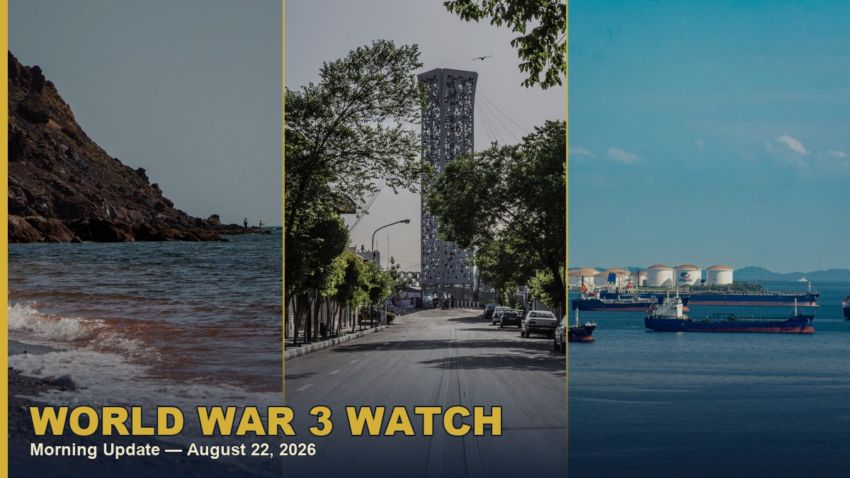
World War 3 Watch — Morning Update — August 22, 2026
- Washington will unveil what it calls “the toughest sanctions in history” on Iran at a Monday press conference — even as oil shipments through the Strait of Hormuz have “virtually halted” (NBC News, 2026).
- Trump frames the escalation as an “economic D-Day” while calling the six-month-old war “a little detour” (Yahoo News, 2026; CNN, 2026).
- China buys 90 percent of Iran’s oil exports, making Beijing the central test of Bessent’s “either with us or against us” campaign (Guancha, 2026, authors’ translation).
- Iran’s central bank chief says oil exports “have actually almost stopped,” but Tehran’s reported counterplay is to strike the Saudi-UAE pipelines bypassing Hormuz (Guancha, 2026, authors’ translation; Phoenix, 2026, authors’ translation).
- In the parallel Taiwan theater, a US Navy P-8A Poseidon transited the strait as Xi Jinping’s anticipated US visit draws closer (Devdiscourse, 2026).
- Israeli strikes hit Lebanon’s Ali Al-Tahir Heights again as fears of a wider regional conflict spread (MSN, 2026).
The Story So Far
Six months into the US-Iran war, the battle is moving from the air to the ledger. Washington is pivoting to what President Trump calls an “economic D-Day” (Yahoo News, 2026).
The first visible casualty is the Strait of Hormuz, where oil shipments have “virtually halted” (NBC News, 2026).
On Monday, Treasury Secretary Scott Bessent will unveil what he promises will be “the toughest sanctions in history” on Iran — aimed not only at Tehran, but at everyone who still does business with it (NBC News, 2026).
The largest such partner is China, which means the economic front now runs directly through Beijing (Guancha, 2026, authors’ translation).
In parallel, a US Navy patrol aircraft transit has kept the Taiwan flashpoint simmering (Devdiscourse, 2026). Across all theaters, neither Tehran nor Washington is pursuing peace talks (NBC News, 2026).
Video: LIVE: US Economic War, Iran Oil Export Halt & Israeli Strikes in Lebanon. Source: Breaking 247 News.
1. Economic D-Day: Washington’s New Phase
Trump announced the new phase on Truth Social last week, promising “economic warfare… on an unprecedented scale” to end the conflict. “These maniacs are on the ropes and these HISTORIC MEASURES will cripple them,” he wrote (Yahoo News, 2026).
Washington’s own framing is triumphant; Chinese state media’s is not. CNR’s headline asks whether America has “exhausted its tricks” (黔驴技穷) while Iran “turns from defense to offense” (转守为攻) (CNR, 2026, authors’ translation).
The machinery of the new phase is already moving: Bessent will hold a press conference at 2 p.m. ET Monday, promising “the toughest sanctions in history” on Iran while urging China to cooperate (NBC News, 2026).
In a CNBC interview, Bessent warned that “you are either with us or against us” in what he called “the largest coordinated economic isolation operation in world history” (Guancha, 2026, authors’ translation).
Chinese commentary notes the echo of the post-9/11 warning that preceded two US decades of “endless wars” in the Middle East (Guancha, 2026, authors’ translation).
The pressure behind the rhetoric is measurable: bread prices in Iran have doubled, a million jobs have been wiped out, inflation reached 87.9 percent in the year to July, and the rial has lost half its value against the dollar (Yahoo News, 2026).
Yet American analysts doubt financial firepower will finish the job. “Trump throughout this conflict has underestimated the willingness of the Iranians to accept pain,” says Alex Vatanka of the Middle East Institute (Yahoo News, 2026).
A Chinese commentary on Sina goes further, arguing that what the US could not achieve on the battlefield it will not achieve by other means — and that other great powers will keep Iran afloat through land corridors via Pakistan, Central Asia and the Caspian (Sina, 2026, authors’ translation).
Video: Bolton warns Russia and China could help Iran rebuild. Source: NewsNation.
2. Beijing in the Crosshairs
Bessent’s vow to punish Iran’s economic partners has one unavoidable target, because China buys 90 percent of Iran’s oil exports (Guancha, 2026, authors’ translation).
So far, Washington has sanctioned Chinese independent refineries while leaving the large Chinese banks that finance the trade untouched (Guancha, 2026, authors’ translation).
Trump’s Wednesday warning listed the tools to be choked off: “oil smuggling, swap lines, cash transfers, exchange houses, ship registration, shell companies — all of these must now stop” (Guancha, 2026, authors’ translation).
Sanctions specialist Brett Erickson argues that no terms Washington offers could make Beijing yield in so public and consequential a way (Guancha, 2026, authors’ translation).
Doing so would mean Beijing “voluntarily allowing the US to decide who China can and cannot do business with” — a precedent he says Beijing will never set (Guancha, 2026, authors’ translation).
Bloomberg Economics’ Chris Kennedy frames the choice at the highest level: “Is the White House willing to put this new economic war above relations with China? If it truly chooses that, the consequences will be very serious” (Guancha, 2026, authors’ translation).
The Atlantic Council’s Josh Lipsky adds that without an international coalition — which does not exist — an economy already punished for forty years cannot be squeezed further without triggering massive Chinese retaliation (Guancha, 2026, authors’ translation).
Beijing has already shown its counter-punch, restricting rare-earth exports and forcing White House concessions in the tariff dispute (Guancha, 2026, authors’ translation). Its foreign ministry rejects “unilateral sanctions without a basis in international law and UN Security Council authorization,” insisting that pressure resolves nothing (Guancha, 2026, authors’ translation).
International Crisis Group analyst Ali Vaez warns the US cannot build a watertight sanctions regime against a country as adept as Iran at evasion — and Trump lacks the patience for results measured in months, not weeks (Guancha, 2026, authors’ translation).
3. Hormuz: Tehran’s Leverage Holds
The economic escalation is unfolding over a strait that has stopped working. Oil shipments through the Strait of Hormuz have “virtually halted,” with Tehran threatening to strike any unauthorized tanker that attempts passage (NBC News, 2026).
Iran’s central bank governor, Abdolnaser Hemmati, conceded this week that “our oil exports have actually almost stopped” (Guancha, 2026, authors’ translation). On that one point, today’s Chinese and English briefs agree.
Tehran still insists it holds the exit card: Iran has warned that if its crude cannot get out, other regional producers’ crude will not get out either (Phoenix, 2026, authors’ translation).
Phoenix’s Tehran correspondent Li Rui flags the vulnerability in that posture: Saudi Arabia and the UAE are both laying pipelines to bypass Hormuz, visibly seeking to reduce the strait’s importance (Phoenix, 2026, authors’ translation).
If the confrontation deepens, she reports, Iran “can absolutely strike those two places,” accelerating oil-price rises to force Washington back to the table (Phoenix, 2026, authors’ translation). Her bottom line: “before the midterm elections, what the US fears most is inflation” (Phoenix, 2026, authors’ translation).
Chinese coverage gives the UAE a far larger role than today’s English-language briefs do. Where US outlets focus on Monday’s sanctions, Chinese analysis calls the UAE’s August 19 decision to sever all trade, commercial and financial ties with Iran the heavier of “two blows” (Sina, 2026, authors’ translation).
The Emirates are Iran’s re-export hub, the laundering point where Iranian oil is repackaged as UAE crude, and the financial window where Iranian gold becomes dollars (Sina, 2026, authors’ translation). The UAE justified the rupture by citing Iranian ballistic missiles fired at its territory (Guancha, 2026, authors’ translation).
The absence of that entire development from the English-language briefs is itself a data point. For a side-by-side read of how each side’s media tells this war, see our narrative-comparison report on how US, Israeli, Iranian, and BRICS media each tell the same war.
4. From Bombs to Blockades: A Six-Month Reckoning
Trump’s own description of the conflict keeps shrinking: he now calls the six-month-old war “a little detour” (CNN, 2026). The battlefield, meanwhile, keeps widening — Israel struck Lebanon’s Ali Al-Tahir Heights again, and the Middle East “remains on edge” (MSN, 2026).
The diplomatic track is equally tangled. US media reported on August 19 that Washington could resume substantive talks with Iran at “some point”; Tehran had insisted a day earlier that no talks of any kind had taken place (CNR, 2026, authors’ translation).
Chinese analysts read the economic turn as an admission. After months of airstrikes failed to deliver Washington’s goals, CNR’s analysis sees the strategy shifting from military pressure to economic strangulation (CNR, 2026, authors’ translation).
The same analysis argues a US withdrawal from the Gulf is not in the cards: port blockades cannot be enforced without the military presence Washington already has around Iran (CNR, 2026, authors’ translation).
American analysts reach a similar conclusion from the opposite direction. The economic offensive “shows the aversion that Trump has to further military engagements,” says Esfandyar Batmanghelidj of the Bourse & Bazaar think tank (Yahoo News, 2026).
In Tehran, hardliners draw the logical conclusion: “diplomacy during a ceasefire is not going to work because the Trump administration is not genuinely committed to ending this war” (Yahoo News, 2026).
5. The Taiwan Flashpoint: A Parallel Standoff
While the Gulf dominates the headlines, the second flashpoint on the World War 3 Watch is simmering in the Taiwan Strait. A US Navy P-8A Poseidon aircraft transited the strait in international airspace, and China’s military monitored the flight closely, according to state-backed Global Times (Devdiscourse, 2026).
Such transits are part of a recurring pattern of US military movements through the waterway that routinely draws Beijing’s ire, given Taiwan’s strategic significance in Sino-American relations (Devdiscourse, 2026).
The timing is pointed: the flight comes as preparations advance for Chinese President Xi Jinping’s anticipated US visit, where Taiwan, trade and technology restrictions are expected to top the agenda with Trump (Devdiscourse, 2026).
Washington is asserting freedom of navigation in one theater while threatening to police China’s oil purchases in another — the exact combination Beijing rejects (Devdiscourse, 2026; Guancha, 2026, authors’ translation).
Is This Actually World War 3?
The honest answer from today’s sources is: not yet. No report in this roundup puts American, Chinese or Israeli forces in direct combat with each other — the Taiwan transit was monitored, not engaged, and the Gulf fighting remains US-Israel-Iran (Devdiscourse, 2026; MSN, 2026).
What the sources do describe is a great-power economic war wrapped around a live regional conflict: the Strait of Hormuz at a standstill, a promised “largest coordinated economic isolation operation in history” aimed at Iran’s partners, and Beijing openly named as the test case (NBC News, 2026; Guancha, 2026, authors’ translation).
Both sides believe the pain can be returned. Tehran is reportedly prepared to push US prices and inflation higher before the midterms, and Beijing has already shown it will answer sanctions with rare-earth leverage (Phoenix, 2026, authors’ translation; Guancha, 2026, authors’ translation).
That reciprocal logic is what this series tracks — and today it is one escalation away from being literal.
What You Can Do Right Now
- Watch fuel and food prices as your early-warning system: Iran’s reported counterplay is precisely to push US prices and inflation higher before the midterms — the pressure point Phoenix’s Tehran correspondent says Washington fears most (Phoenix, 2026, authors’ translation).
- Build a buffer against supply shocks now: our survival skills and preparedness guide covers the practical basics for energy- and food-price disruptions.
- Read both sides before you decide what matters: today’s Chinese and English briefs disagree on the UAE cutoff, on Hormuz, and on whether sanctions can actually break Iran (Sina, 2026, authors’ translation; Yahoo News, 2026).
SUPPORT KEMETIC MINDS
Enjoying this coverage? Back the work and find every way to connect with us in one place.
Support the Page →Kemetic Minds Analysis
This roundup pulled directly from the day’s English- and Chinese-language wires side by side, because the gap between what each side chooses to report is often as informative as any single strike count. Treat the Key Takeaways above as the verified factual floor, and the framing differences noted in the sections above as the more interesting, harder-to-fake signal about where this war is actually headed next.
References
- MSN. (2026, August 22). US-Israel-Iran war latest news: Lebanon's Ali Al-Tahir Heights hit again by Israeli strikes as regional tensions rise. msn.com
- Yahoo. (2026, August 21). Trump wants to unleash ‘economic D-Day’. But Iran is no stranger to pain. yahoo.com
- Devdiscourse. (2026, August 22). Tensions Over Taiwan Strait: A Military Standoff. devdiscourse.com
- MSN. (2026, August 22). US-Israel-Iran war latest live news: Washington prepares toughest-ever Iran sanctions as oil traffic through Hormuz virtually stops. msn.com
- NBC News. (2026, August 22). U.S., Iran keep up hostile rhetoric ahead of new sanctions. nbcnews.com
- CNN. (2026, August 22). Trump calls Iran war ‘a little detour’ as Tehran keeps up defiance ahead of looming sanctions. cnn.com
- 央广网. (2026, August 22). 美伊局势:美国“黔驴技穷”,伊朗“转守为攻”? [US-Iran Standoff: US at Wit's End as Iran Goes on Offensive?]. cnr.cn
- 东方财富. (2026, August 22). 特朗普再称:霍尔木兹海峡是美国的领土!他还称伊朗非常渴望达成协议 [Trump again claims: The Strait of Hormuz is U.S. territory! He also says Iran is very eager to make a deal.]. wap.eastmoney.com
- 凤凰网. (2026, August 22). 伊朗正在密谋经济战打击特朗普?凤凰记者:可以打击两个地方 [Is Iran plotting economic warfare against Trump? Phoenix reporter: Two targets are vulnerable.]. news.ifeng.com
- 手机新浪网. (2026, August 22). 伊朗遭到两重打击!这两天,伊朗遭到两重打击。其一,根据财联社等媒体8.21报道,贝森特当地时间周四表示,将对伊朗实施史上最严经济制裁。制裁措施包括封杀伊朗石油走私、打击伊空壳公司、冻结伊朗海外资产、打击伊朗影子舰队等等。美国所谓的“史上最严经济 [Iran suffers a double blow!]. sina.cn
- 观察者. (2026, August 22). “美国想管中国跟谁做生意?中方绝不答应”-观察者网 [The US wants to control who China does business with? China will never agree — Observer]. guancha.cn
Investigative Methodology: This roundup is generated on a fixed schedule (noon and evening, America/Chicago) from live English- and Chinese-language wire sources. Every claim is grounded in fetched source text with an APA7 in-text citation; translated Chinese-language quotes are marked “authors’ translation.” Every video embed is verified to be a real, existing video via YouTube’s oEmbed endpoint before publication — none are written by the drafting model. No Wikipedia sources are used.
Stay Connected

Kemetic Minds Editorial Desk
Verified NewsroomPrimary-sourced investigative intelligence on civil rights, voting rights, federal policy, and consumer protection. Sourced from primary legal filings, government statistics, and direct field reporting.