KEMETIC MINDS
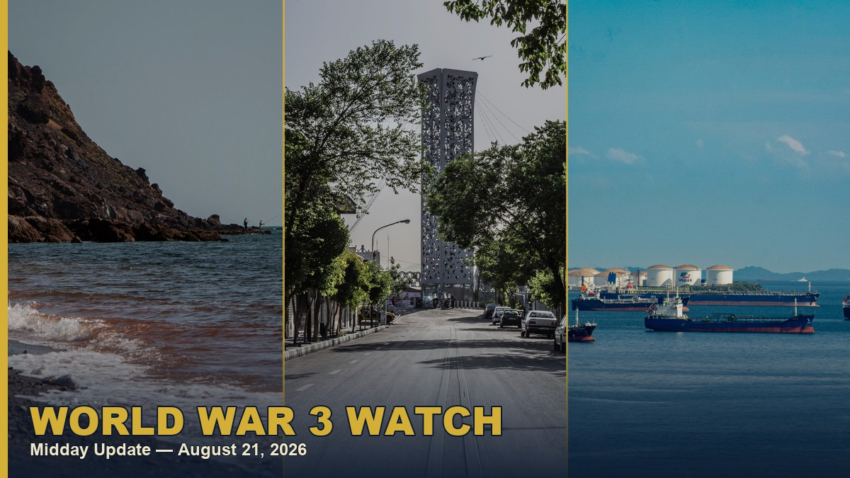
World War 3 Watch — Midday Update — August 21, 2026
- The United States announces “toughest sanctions in history” against Iran, targeting any nation providing economic “lifelines” to Tehran (IBTimes, 2026).
- China, buying as much as 90% of Iran’s oil exports, signals defiance, stating that “sanctions and pressure are not the way to solve problems” (RFI, 2026, authors’ translation).
- Oil prices spike to nearly $94 per barrel as markets brace for tighter supply through the Strait of Hormuz (RFI, 2026, authors’ translation).
- Iranian military leadership issues a “devastating” response threat, warning of broad retaliation across land, sea, air, and cyber domains (Shangbao Indonesia, 2026, authors’ translation).
- UAE announces suspension of all commercial and financial transactions with Iran, aligning with US pressure (RFI, 2026, authors’ translation).
The Story So Far
The Trump administration has escalated its pressure campaign against Iran, unveiling what Treasury Secretary Scott Bessent calls the “toughest sanctions in history” (IBTimes, 2026). The new measures target not just Iran, but any country or financial institution providing economic support to Tehran, creating a “one-two punch” alongside the existing naval blockade (IBTimes, 2026).
China, Iran’s largest oil buyer, has emerged as the central obstacle to Washington’s strategy. Beijing has responded defiantly, dismissing the sanctions as illegal unilateral measures and refusing to align with US demands (RFI, 2026, authors’ translation).
The confrontation is reshaping global energy markets, with oil prices spiking as traders weigh the risk of a prolonged blockade in the Strait of Hormuz (Fox News, 2026). At the same time, the parallel flashpoint between China and Taiwan continues to simmer in the background, with Beijing signaling readiness to resist economic coercion across multiple fronts.
Video: US SEVERES China's Biggest Oil Pipeline! Iranian Oil Trade Crashes As Blockade Works. Source: The Daily Jagran.
Economic D-Day: Sanctions, China’s Defiance, and the Oil Markets
President Trump has branded the new economic offensive “economic D-Day,” a reference to the scale of the financial assault being prepared against Iran (RFI, 2026, authors’ translation). Writing on his Truth Social platform, Trump declared the United States would impose an “unprecedented scale of economic war and isolation” on Iran, warning that any nation providing a “lifeline” would face “tremendous economic consequences” (RFI, 2026, authors’ translation).
Treasury Secretary Bessent has confirmed that detailed sanctions will be announced at a press conference on August 24 (IBTimes, 2026). He framed the measures as a stark choice for the international community: “You’re either on our side or on the other side” (RFI, 2026, authors’ translation).
China’s response has been unequivocal. Chinese Foreign Ministry spokesman Lin Jian stated: “China opposes illegal unilateral sanctions that have no basis in international law and have not been authorized by the UN Security Council” (RFI, 2026, authors’ translation). He added, “Military means, sanctions, and pressure do not help solve problems; they only exacerbate tensions, and escalating the situation does not serve anyone’s interests” (RFI, 2026, authors’ translation).
This defiance has significant implications. China accounted for nearly 90% of Iran’s crude oil exports as of 2023, according to US Energy Information Administration data (IBTimes, 2026). Chinese analysts argue Beijing has “enough oil to withstand the loss of Iranian crude” and can even squeeze US critical mineral supplies in retaliation (The New York Times, 2026).
Market reactions have been immediate. Brent crude spiked to near $94 per barrel, a rise of more than 2%, as investors priced in the risk of tighter global supply (RFI, 2026, authors’ translation). The Strait of Hormuz, through which about one-fifth of global oil trade passes, remains well below pre-war traffic levels (RFI, 2026, authors’ translation).
Video: Iran’s Pezeshkian Shocks Trump: ‘End The War Today’ As US Threatens To ‘Collapse’ Tehran Regime. Source: MIRROR NOW.
The Hormuz Flashpoint: Military Stalemate and Economic War
Iran has dismissed the economic pressure as a sign of American weakness. Foreign Minister Abbas Araghchi posted on social media, “Doubling down on failed policies will only bring further failure and the hostility of the Iranian people” (RFI, 2026, authors’ translation). He accused the United States of “economic terrorism” that threatens not just Iran, but the global economy and the sovereignty of other nations (Shangbao Indonesia, 2026, authors’ translation).
The Iranian military has issued its own warnings. General Staff Chief Abdollah Rahimi stated, “The Iranian armed forces are fully prepared in land, sea, air, air defense, and cyberspace to respond to new threats from the enemy with devastating strikes and punishment” (Shangbao Indonesia, 2026, authors’ translation).
Iranian Revolutionary Guard Corps spokesman Mohebbi echoed this sentiment, warning that Iran would use “more destructive weapons” in response to any new war, including missiles with greater range and precision (Shangbao Indonesia, 2026, authors’ translation).
The escalation comes after two failed ceasefires in April and June that aimed to restore Hormuz shipping (RFI, 2026, authors’ translation). The Trump administration is betting that economic collapse will bring Tehran to the negotiating table, but Iranian officials report that hyperinflation, while severe, has not yet caused a collapse in basic goods availability (RFI, 2026, authors’ translation).
The economic war also carries domestic American risks. Economist Peter Schiff has argued the sanctions will “backfire,” predicting a weaker dollar and rising food and energy prices (RFI, 2026, authors’ translation). Meanwhile, the USS Abraham Lincoln has remained on extended deployment, prompting concerns about crew fatigue, and the USS George Washington has been dispatched to the region to relieve it (RFI, 2026, authors’ translation).
Kpler shipping data shows only seven commercial vessels transited the Strait of Hormuz on August 20, down from 14 the previous day, highlighting the blockade’s impact on global trade (Shangbao Indonesia, 2026, authors’ translation).
The China-Taiwan Flashpoint: A Parallel Crisis
Washington’s sanctions strategy is deeply intertwined with the broader US-China confrontation. The Trump administration is directly courting Beijing to join the anti-Iran coalition, even as it pressures China on trade and technology (IBTimes, 2026). Treasury Secretary Bessent has explicitly called on China to “align with us” (RFI, 2026, authors’ translation).
Chinese analysts interpret this pressure as a sign of American decline rather than strength. Wu Xinbo, director of the Center for American Studies at Fudan University, told Guancha that the Trump administration’s threats reveal its dilemma: “They make these threats, not because they think it’s feasible, but because they have no other options” (Guancha, 2026, authors’ translation).
The subtext of this confrontation extends to the Taiwan Strait. China’s rejection of US unilateral sanctions is part of a broader assertion of sovereignty against American intervention (Guancha, 2026, authors’ translation). While the war in the Middle East dominates headlines, the parallel dynamic of US-China tension over Taiwan continues to define the global balance of power.
In response to US pressure, Beijing has been diversifying its energy sources, increasing purchases of Russian crude to offset potential supply disruptions from Iran (The New York Times, 2026). This has ripple effects on other markets, with Indian imports of Russian oil facing pressure as Chinese buyers outcompete them (IDN Financials, 2026).
The Chinese government has also signaled its willingness to counterpunch in other domains, including critical minerals. Analysts note that China’s export controls on key minerals, tested during last year’s trade friction, demonstrate its supply chain leverage over US military manufacturers (Guancha, 2026, authors’ translation).
Media Distortion and the Battle for Information
The divergence between English-language and Chinese-language coverage of this conflict reveals fundamentally different narratives. Western outlets focus on the existential threat Iran poses and the effectiveness of US pressure, often citing anonymous “trade sources” and administration officials (MSN, 2026; IBTimes, 2026).
Chinese media, by contrast, frame the conflict as evidence of American imperial overreach and decline. The Guancha commentary “Trump using Iran to apply pressure actually shows he’s out of moves” typifies this framing, emphasizing that US threats reflect strategic weakness rather than strength (Guancha, 2026, authors’ translation).
The New York Times quote that Beijing can “squeeze U.S. critical mineral supplies and has enough oil to withstand the loss of Iranian crude” is presented in Chinese media as a validation of Beijing’s strength and a warning that the United States could ultimately pay a high price for this pressure campaign (The New York Times, 2026; Guancha, 2026, authors’ translation).
This information war extends to the reporting of Iranian resilience. While Western outlets often describe Iran’s economy as near collapse, the Chinese-language source cites former Central Bank advisor Mehrdad Sepahvand saying that although “hope has clearly diminished, it hasn’t completely disappeared, so the situation isn’t as bad as we imagine” (RFI, 2026, authors’ translation).
For a deeper dive into how each side constructs its narrative, see our narrative-comparison report on how US, Israeli, Iranian, and BRICS media each tell this war.
Is This Actually World War 3?
Based on today’s sources, the world is not in a formal World War III in the conventional sense, but the structure of the conflict is strikingly global. The United States is now pursuing economic warfare against Iran while simultaneously managing a strategic rivalry with China, and both flashpoints intersect with the ongoing war in Ukraine (RFI, 2026, authors’ translation).
The economic dimensions of this conflict extend far beyond bilateral relations. Trade and financial flows between Iran and the UAE, Turkey, Russia, and China are all directly targeted by the new sanctions (RFI, 2026, authors’ translation).
American economic pressure is already having global ripple effects, from oil prices to critical mineral supply chains to the stability of the dollar itself (The New York Times, 2026; RFI, 2026, authors’ translation). Whether this escalates into a broader hot war depends on whether China and Iran remain within a purely economic confrontation, or whether the military flashpoints in the Strait of Hormuz and Taiwan Strait spiral further.
For now, the conflict is a combination of proxy tensions, economic coercion, and information warfare—a modern great-power struggle that is not yet a world war, but has the ingredients for one. For those preparing for the possibility of further escalation, we recommend reviewing our survival skills and preparedness guide.
What You Can Do Right Now
- Track energy prices and supply chains in your local market—sustained blockade and sanctions will impact global food and fuel costs, as analysts warn of both price spikes and shortages (RFI, 2026, authors’ translation).
- Diversify your information sources. Consume both Western and Chinese-languagemedia coverage of the conflict to identify the information war framing and make more informed decisions about the real risks (Guancha, 2026, authors’ translation).
SUPPORT KEMETIC MINDS
Enjoying this coverage? Back the work and find every way to connect with us in one place.
Support the Page →Kemetic Minds Analysis
This roundup pulled directly from the day’s English- and Chinese-language wires side by side, because the gap between what each side chooses to report is often as informative as any single strike count. Treat the Key Takeaways above as the verified factual floor, and the framing differences noted in the sections above as the more interesting, harder-to-fake signal about where this war is actually headed next.
References
- MSN. (2026, August 21). Iranian oil supplies to China tighten as US blockade cuts Tehran's crude exports. msn.com
- Bloomberg. (2026, August 21). Iranian President Calls for War’s End. bloomberg.com
- MSN. (2026, August 21). What we're watching: China calls Trump’s bluff over new Iran sanctions, Brazil tries to cash in on rare earth reserves, & more. msn.com
- Fox News. (2026, August 21). Iran warns of ‘devastating’ response to US sanctions as America prepares for new phase of war. foxnews.com
- The New York Times. (2026, August 21). Why China Thinks It Can Resist Trump’s Economic Threats on Iran. nytimes.com
- Ibtimes. (2026, August 21). Trump Turns Tough, Unveils Severe Iran Sanctions As Naval Blockade Escalates in Hormuz. ibtimes.sg
- RFI. (2026, August 21). 美国专栏 – 特朗普祭“经济D日” 能否逼伊朗结束战争 – RFI [US Column — Trump's 'Economic D-Day': Can It Force Iran to End the War?]. rfi.fr
- Shangbao Indonesia. (2026, August 21). 伊朗誓言对美国“史上最严厉的经济打击”做出“毁灭性”回应 [Iran vows ‘devastating’ response to U.S.’s ‘most severe economic strike in history’]. shangbaoindonesia.com
- RFI. (2026, August 21). 美国点名中国:要求加入针对伊朗的大规模经济制裁行动,中方作出回应 [US Calls on China to Join Sweeping Sanctions on Iran; Beijing Responds]. rfi.fr
- 观察者. (2026, August 21). “特朗普拿伊朗施压,恰恰说明他没招了”-观察者网 [Trump’s pressure on Iran only shows he’s run out of options]. guancha.cn
- idnfinancials.com. (2026, August 21). 中国在俄罗斯石油贸易中取代印度,印度进口受压 [China Replaces India in Russian Oil Trade, Squeezing Indian Imports]. idnfinancials.com
Investigative Methodology: This roundup is generated on a fixed schedule (noon and evening, America/Chicago) from live English- and Chinese-language wire sources. Every claim is grounded in fetched source text with an APA7 in-text citation; translated Chinese-language quotes are marked “authors’ translation.” Every video embed is verified to be a real, existing video via YouTube’s oEmbed endpoint before publication — none are written by the drafting model. No Wikipedia sources are used.
Stay Connected

Kemetic Minds Editorial Desk
Verified NewsroomPrimary-sourced investigative intelligence on civil rights, voting rights, federal policy, and consumer protection. Sourced from primary legal filings, government statistics, and direct field reporting.