
KEMETIC MINDS
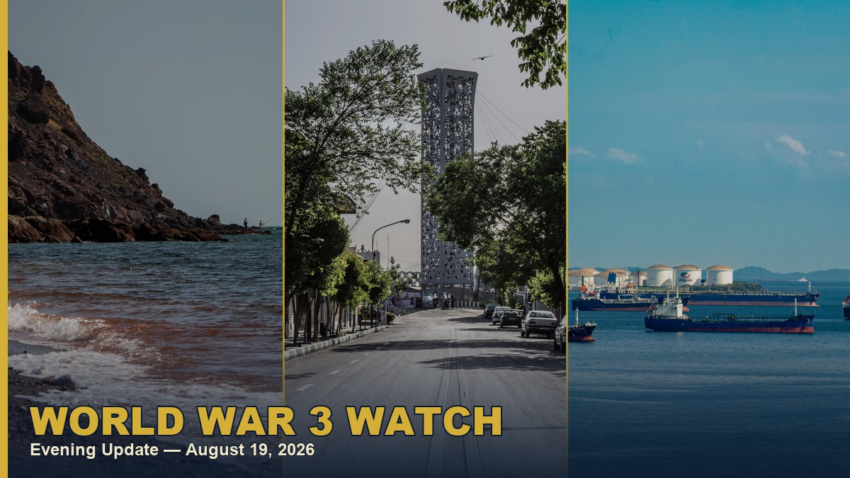
World War 3 Watch — Evening Update — August 19, 2026
- The strait is no longer closed — it is controlled. A US task force commanded by the 82nd Airborne’s headquarters has run a secret southern shipping lane for two months, moving nearly 10 million barrels of oil a day (Beijing News, 2026, authors’ translation), roughly half the pre-war volume (Sina Finance, 2026, authors’ translation).
- Iran is weighing offense. With the strait deadlock unresolved, Tehran is considering striking US military facilities in Europe and cutting undersea fiber-optic cables in the waterway (Xinlan Network, 2026, authors’ translation; Huasheng Online, 2026, authors’ translation).
- The UAE has severed ties with Tehran. All trade, commercial exchanges, and financial transactions — a relationship worth about $28 billion in 2024 — are suspended until further notice (VOA Chinese, 2026, authors’ translation).
- Washington’s “economic D-Day” is imminent. Treasury Secretary Scott Bessent promises an unprecedented economic isolation package, with the strait sealed against Iranian shipping (MSN, 2026; VOA Chinese, 2026, authors’ translation).
- The fleet is straining. Reported USS Lincoln supply problems expose US Navy limits in a prolonged war, experts say (MSN, 2026), even as CENTCOM reports it has diverted 65 commercial ships and boarded two (Huasheng Online, 2026, authors’ translation).
- Trump’s line wobbled. He called Iran talks “dead” while insisting the strait is “open and operating” — then said talks could resume “at some point,” on condition Iran completely abandons its nuclear weapons (Fox News, 2026; Huasheng Online, 2026, authors’ translation).
The Story So Far
By the evening of August 19, the defining fact of the day is that the Strait of Hormuz has become a contested, working highway — and the US military is the one running it. A secret convoy operation is moving nearly 10 million barrels of oil a day out of the Gulf, roughly half the pre-war flow (Beijing News, 2026, authors’ translation; Sina Finance, 2026, authors’ translation).
Iran, squeezed on the water, is signaling a strategic shift from defense to offense. Strikes on US facilities in Europe and on undersea cables are reportedly on the table (Xinlan Network, 2026, authors’ translation; Huasheng Online, 2026, authors’ translation).
Washington is pairing its maritime control with an economic siege. The UAE has cut all ties with Tehran, and Treasury Secretary Scott Bessent promises an “unprecedented” isolation package this week (MSN, 2026; VOA Chinese, 2026, authors’ translation).
The same day found the US Navy stretched, the White House sending mixed signals on diplomacy, and the war’s shadow falling on Baghdad, Tokyo, Pyongyang, and Gaza (MSN, 2026; Fox News, 2026; Huasheng Online, 2026, authors’ translation).
Video: BIG! Iran First Attacks, Then Captures UAE-Linked Ship In Chilling Hormuz Assault | Watch. Source: Times Of India.
1. The Secret Convoy: How the 82nd Airborne Opened Hormuz’s Southern Lane
The most consequential news of the day was not delivered at a podium. It arrived through Axios reporting, picked up by Xinhua and spread through Chinese-language media — a quiet US military operation to open a shipping corridor through the Strait of Hormuz (Beijing News, 2026, authors’ translation; Sina Finance, 2026, authors’ translation).
The operation has run for weeks, and over the past two weeks 15 to 20 tankers a night have used a southern lane along the Omani coast (Beijing News, 2026, authors’ translation). Volumes have climbed to nearly 10 million barrels a day, about half the pre-war average — and on some nights, 15 to 20 million barrels leave the Gulf (Sina Finance, 2026, authors’ translation).
The effort is commanded from Fort Bragg, North Carolina, by the headquarters of the Army’s 82nd Airborne Division (Beijing News, 2026, authors’ translation). The task force does more than escort loaded tankers out: it also guides empty tankers from the Arabian Sea into the Gulf to load at the UAE, Bahrain, and Kuwait (Beijing News, 2026, authors’ translation).
Vessels sail in large convoys at set times, pass multiple checkpoints, and report positions — while US fighters orbit overhead to shoot down Iranian cruise missiles and drones (Beijing News, 2026, authors’ translation). Some ships have been hit, but officials say most Iranian attacks are intercepted (Beijing News, 2026, authors’ translation).
The operation became possible, officials said, after a two-week CENTCOM campaign degraded Iran’s radar and maritime surveillance systems (Sina Finance, 2026, authors’ translation).
Tehran now operates largely in a “monitoring blind spot,” firing drones and cruise missiles toward inferred bearings rather than confirmed targets (Sina Finance, 2026, authors’ translation). On Monday night, US forces shot down eight Iranian drones and two cruise missiles (Sina Finance, 2026, authors’ translation).
An American official summarized the new balance of power: “We have controlled the southern corridor of the Strait of Hormuz for two months. The IRGC will make trouble, but the strait is not under their control — we control it” (Sina Finance, 2026, authors’ translation).
Tuesday night’s plan called for more than 20 vessels, with roughly 15 million barrels expected outbound (Sina Finance, 2026, authors’ translation).
Notice the coverage gap. The operational texture of this section comes from Chinese-language outlets relaying Axios, while the English-language articles in front of us frame the same waterway through Trump’s assurance that it is “open and operating” (Fox News, 2026) and the USS Lincoln’s supply crisis (MSN, 2026).
The English-language items carry the presidential line and the Navy’s strain; the Chinese-language roundup carries the operation’s mechanics, Iran’s counter-options, and the war’s wider map. Keep that asymmetry in mind as you read on.
Video: UAE Accuses Iran Of Firing Missiles On Shipping: Trump Claims Hormuz 'A New U.S. Territory' | WION. Source: WION.
2. Iran’s Next Move: From Defense to Attack
If the strait is slipping from Tehran’s grip, the reported Iranian answer is to widen the war rather than accept the loss. With the deadlock unresolved, Chinese outlets report that Iranian leaders are considering a shift from defense to offense — including strikes on US military facilities in Europe (Xinlan Network, 2026, authors’ translation).
British reporting relayed in the Chinese press adds detail: Tehran’s senior leadership is weighing options that include attacking US military targets in Europe and cutting undersea fiber-optic cables in the Strait of Hormuz (Huasheng Online, 2026, authors’ translation). Cutting the cables would strike global communications, not just shipping.
The public messaging is already moving. Mohammad Reza Naqdi, a senior adviser to the commander-in-chief of the Islamic Revolutionary Guard Corps, said the war proves the US and Israel are “much weaker” than imagined (Huasheng Online, 2026, authors’ translation).
Iran’s purely defensive strategy, he argued, only invited repeated attack. An offensive strategy could deliver a higher level of deterrence — forcing the enemy to retreat and stripping it of the courage to launch new strikes (Huasheng Online, 2026, authors’ translation).
The pressure on Tehran is concrete, not just rhetorical. CENTCOM says it has guided 65 commercial ships to change course, rendered three ships incapacitated, and boarded and inspected two as it continues to enforce the maritime blockade of Iran (Huasheng Online, 2026, authors’ translation).
Iran has damaged some vessels, but US officials say the majority of attacks are intercepted (Beijing News, 2026, authors’ translation).
3. The Economic D-Day: UAE Severs Ties as Washington’s Siege Looms
While the military runs the waterway, Washington is assembling a financial siege. US media describe it as an “economic D-Day” against Iran — the “most crushing” operation ever (MSN, 2026).
The announcement coincides with a dramatic regional realignment: the UAE has suspended all trade and financial ties with Iran, citing security concerns following missile incidents (MSN, 2026).
Abu Dhabi’s statement, issued Tuesday, halts “all trade, commercial exchanges and financial transactions… until further notice,” according to Afra Al Hameli, director of strategic communication at the UAE Foreign Ministry (VOA Chinese, 2026, authors’ translation).
The move came hours after the UAE accused Tehran of firing two ballistic missiles at its territory — missiles its air defense tracked falling into the sea, apparently aimed at maritime traffic (VOA Chinese, 2026, authors’ translation). Iran denies the claim (VOA Chinese, 2026, authors’ translation).
The commercial rupture is significant: UAE-Iran trade stood at about $28 billion in 2024, much of it Emirati exports and re-exports (VOA Chinese, 2026, authors’ translation). Both English and Chinese coverage carry the rupture, but the Chinese-language version adds the trade figures and the full Bessent quote (MSN, 2026; VOA Chinese, 2026, authors’ translation).
The decision was coordinated at the highest level. Trump called UAE President Sheikh Mohamed bin Zayed Al Nahyan, and Secretary of State Marco Rubio spoke with UAE National Security Adviser Sheikh Tahnoon bin Zayed Al Nahyan — with Rubio emphasizing freedom of navigation in the Strait of Hormuz (VOA Chinese, 2026, authors’ translation).
Treasury Secretary Scott Bessent says the coming package will be an “unprecedented economic isolation combination,” with the strait kept sealed so nothing enters or leaves Iranian ports (VOA Chinese, 2026, authors’ translation).
Set beside Trump’s same-day insistence that the strait is “open and operating” (Fox News, 2026), the design comes into focus — a one-way valve, with oil flowing out for the world and nothing flowing in for Iran.
4. The Fraying Fleet: USS Lincoln and the Cost of a Long War
Sustaining that valve is taking a visible toll on US naval power. Reports of dire conditions aboard the USS Lincoln underscore supply-chain challenges and raise questions about Washington’s plans going forward, experts say (MSN, 2026).
The Lincoln’s troubles land at a moment of maximum demand. The same day’s reporting shows CENTCOM actively diverting 65 commercial ships, incapacitating three, and boarding two in the blockade of Iran (Huasheng Online, 2026, authors’ translation) — while a separate command runs the nightly oil convoy (Beijing News, 2026, authors’ translation).
That an Army airborne division headquarters commands a naval shipping lane — even as the Navy’s flagship carrier deals with reported supply problems — suggests how far the services have been stretched for this fight.
A war expected to be about carrier strikes has become a war about logistics, convoys, and endurance.
5. The Wider War Map: Baghdad, Tokyo, Pyongyang, and the Other Fronts
Today’s Chinese-language roundup stretches well beyond the Gulf. In Baghdad, Iranian parliament speaker Mohammad Qalibaf met Iraqi President Amidi and parliament speaker Halbusi (Huasheng Online, 2026, authors’ translation).
Halbusi urged Iran to grant Iraq “special arrangements” for exporting its own oil through the Strait of Hormuz. Qalibaf reaffirmed Iran’s commitment to bilateral cooperation, particularly in trade and economy (Huasheng Online, 2026, authors’ translation).
In the Indo-Pacific, the war’s shadow falls on Tokyo. Japanese media report the 2027 defense budget request could reach about 10 trillion yen, and protesters gathered outside the National Diet on August 19 to oppose Prime Minister Takaichi’s military buildup and constitutional revision push (Huasheng Online, 2026, authors’ translation).
LDP support has fallen four points to 23 percent — the lowest since the Takaichi cabinet took office last October (Huasheng Online, 2026, authors’ translation). The government is also pressing its ruling-coalition partner, the Japan Innovation Party, to go “further” on reviewing the “Three Non-Nuclear Principles” — including its ban on bringing nuclear weapons into Japan — and Tokyo plans to test-fire long-range missiles at Australian ranges (Huasheng Online, 2026, authors’ translation).
On the Korean file, Trump told reporters he expects to meet Kim Jong-un later this year (Huasheng Online, 2026, authors’ translation).
Kim Yo-jong said she knows nothing of recent US-North Korean leader communications. She dismissed Ukrainian claims of North Korean troop increases in Russia as “self-produced drama” (Huasheng Online, 2026, authors’ translation).
The Middle East’s other fronts remain hot. An Israeli airstrike on the Gaza City police headquarters killed nine people and wounded 15 (Huasheng Online, 2026, authors’ translation).
Israeli forces arrested at least 31 Palestinians, including the Palestinian Authority’s Jerusalem Affairs Minister Ashraf al-Awar. Israel’s strike on a Syrian airbase drew condemnation from both Damascus and Ankara (Huasheng Online, 2026, authors’ translation).
Even the day’s non-military news carries the texture of a world under strain: more than 100 people died in a gold mine landslide in the Central African Republic, per initial reports (Huasheng Online, 2026, authors’ translation).
Is This Actually World War 3?
Nothing in today’s sources describes a direct clash between NATO and Russia or between the US and China. By the classic definition, this is still a regional war — but it is contained in name only.
Today’s reporting shows the war acquiring new fronts and new tools: a secret oil convoy, a degraded Iranian surveillance network, a possible strike on US bases in Europe, an economic siege, and a Gulf state severing $28 billion in trade (Beijing News, 2026, authors’ translation; Sina Finance, 2026, authors’ translation; Xinlan Network, 2026, authors’ translation; Huasheng Online, 2026, authors’ translation; VOA Chinese, 2026, authors’ translation).
The reported Iranian option of striking US military facilities in Europe would carry the war onto European soil — a step that would force a response far beyond the Gulf (Xinlan Network, 2026, authors’ translation; Huasheng Online, 2026, authors’ translation).
There is also a narrative war underway, and today’s sources display it in real time: Chinese-language outlets publish operational claims of US control over the strait, while English-language front pages lead with presidential reassurance and carrier strain (Beijing News, 2026, authors’ translation; Sina Finance, 2026, authors’ translation; Fox News, 2026; MSN, 2026).
That is precisely the pattern in our narrative-comparison report on how US, Israeli, Iranian, and BRICS media each tell this war — and today was a textbook demonstration of it.
For the series’ other flashpoint, China-Taiwan, today’s sources are silent. The day belonged entirely to the Gulf and its global ripples.
The honest verdict: this is not yet a world war, but it is no longer just a regional one. When a single evening update must track a Gulf oil corridor, European basing options, undersea cables, Japan’s defense budget, Korean diplomacy, Gaza, Syria, and a Central African mining disaster, the line between “regional war with global consequences” and “world war” is thinning by the hour (Huasheng Online, 2026, authors’ translation).
What You Can Do Right Now
- Watch the nightly volume of the Hormuz corridor. If outflows fall from the current roughly 10 million barrels a day, expect fuel and shipping-cost shocks within weeks — and check our survival skills and preparedness guide to buffer your household.
- Read across the language divide before you lock in a view. The US and Chinese press are reporting different wars from the same strait — today’s briefing was a live case study.
- Run a two-week home-stock scenario: food, water, medicine, and cash. Fuel and freight-price shocks from a Hormuz disruption reach store shelves before they reach the headlines.
SUPPORT KEMETIC MINDS
Enjoying this coverage? Back the work and find every way to connect with us in one place.
Support the Page →Kemetic Minds Analysis
This roundup pulled directly from the day’s English- and Chinese-language wires side by side, because the gap between what each side chooses to report is often as informative as any single strike count. Treat the Key Takeaways above as the verified factual floor, and the framing differences noted in the sections above as the more interesting, harder-to-fake signal about where this war is actually headed next.
References
- Fox News. (2026, August 19). Trump says Iran talks are dead, insists Strait of Hormuz is 'open and operating'. foxnews.com
- MSN. (2026, August 19). USS Lincoln woes highlight US Navy limits in prolonged Iran war: Experts. msn.com
- MSN. (2026, August 19). Trump unleashes 'economic D-Day' on Iran: 'Most crushing' operation ever. msn.com
- 新京报. (2026, August 19). 美媒:美军开展秘密行动在霍尔木兹海峡打通运油航道 [U.S. media: U.S. military carries out covert operation to open oil shipping route in Strait of Hormuz]. bjnews.com.cn
- 新蓝网. (2026, August 19). 海峡僵局未解 伊朗考虑转守为攻打击驻欧美军设施 [As Strait Standoff Persists, Iran Considers Striking US Bases in Europe]. cztv.com
- 新浪财经. (2026, August 19). 报道:美国开展行动通过霍尔木兹海峡运输石油 [Report: US launches operation to transport oil through Strait of Hormuz]. finance.sina.com.cn
- 美国之音. (2026, August 19). 阿联酋以地区局势升级为由暂停与伊朗的贸易往来,美国即将推出前所未有的经济措施 [UAE suspends trade with Iran citing escalating regional tensions, as US prepares unprecedented economic measures.]. voachinese.com
- 华声在线. (2026, August 19). 国际新闻早知道丨伊朗考虑转守为攻打击驻欧美军设施 日本民众反对高市扩军修宪 [International News Briefing | Iran Weighs Offensive Strikes on US Facilities in Europe; Japanese Public Opposes Takaichi's Military Buildup and Constitutional Revision]. m.voc.com.cn
Investigative Methodology: This roundup is generated on a fixed schedule (noon and evening, America/Chicago) from live English- and Chinese-language wire sources. Every claim is grounded in fetched source text with an APA7 in-text citation; translated Chinese-language quotes are marked “authors’ translation.” Every video embed is verified to be a real, existing video via YouTube’s oEmbed endpoint before publication — none are written by the drafting model. No Wikipedia sources are used.
Stay Connected

Kemetic Minds Editorial Desk
Verified NewsroomPrimary-sourced investigative intelligence on civil rights, voting rights, federal policy, and consumer protection. Sourced from primary legal filings, government statistics, and direct field reporting.