KEMETIC MINDS
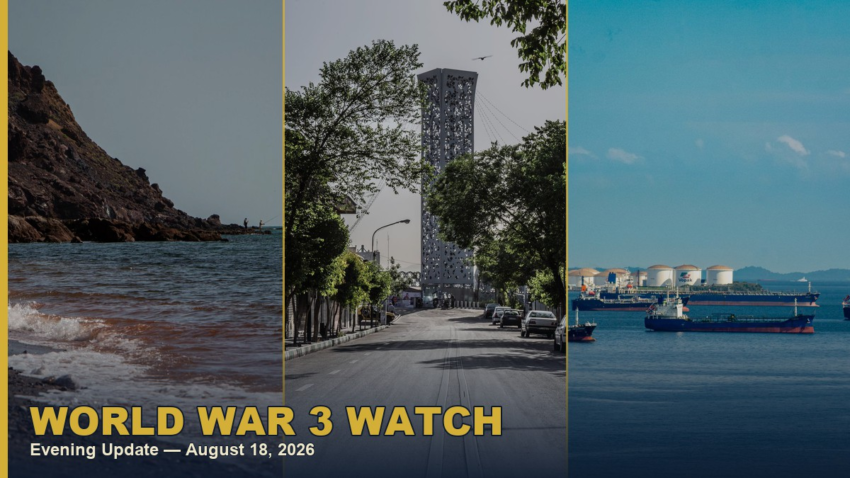
World War 3 Watch — Evening Update — August 18, 2026
- Trump posted a Truth Social map labeling the Strait of Hormuz “new US territory” and said no talks with Iran are happening or scheduled (Yahoo News, 2026; RTHK, 2026).
- Iran’s parliament speaker says the strait stays closed until the US lifts its naval blockade and sanctions and unfreezes assets; Trump insists it is “open and operating” (Wallstreetcn, 2026, authors’ translation; RTHK, 2026).
- A tanker was hit by unknown munitions leaving port, and the UAE tracked two Iranian ballistic missiles aimed at “maritime traffic” (Wallstreetcn, 2026, authors’ translation; RTHK, 2026).
- The Pentagon is weighing a smaller Persian Gulf footprint after Iranian strikes damaged more than 200 US facilities and killed 10 American troops (Caus News, 2026, authors’ translation).
- Taiwan detained a drone company founder for selling the army drones built with Chinese parts — the first such national-security case (VOA Chinese, 2026, authors’ translation).
- Oil prices are climbing and borrowing costs sit at multi-decade highs as investors price a long standoff (RTHK, 2026).
The Story So Far
The 60-day window opened by June’s US-Iran memorandum of understanding expired Monday with no breakthrough, and Tuesday brought the sharpest language yet (Yahoo News, 2026).
Trump posted a map of the Strait of Hormuz labeled “new US territory,” declared there are “no talks or conversations going on, or scheduled” with Iran, and insisted the strait is open — even as Tehran says it stays shut and a tanker came under fire (Yahoo News, 2026; RTHK, 2026).
Markets read the deadlock as durable: oil rose again, stocks sagged, and borrowing costs for major economies including the US touched multi-decade highs (RTHK, 2026).
Beyond Hormuz, the Houthis are pressuring a second chokepoint, the Pentagon is quietly planning a smaller Gulf footprint, and Taiwan opened its first national-security case over Chinese drone parts (Wallstreetcn, 2026, authors’ translation; Caus News, 2026, authors’ translation; VOA Chinese, 2026, authors’ translation).
Video: Morning News NOW Full Episode – Aug. 18. Source: NBC News.
1. Hormuz: A Strait Painted ‘New US Territory’
Trump’s Truth Social map followed his Friday suggestion that he would declare the strait US territory “pretty soon,” and his Monday Oval Office remark that “we control it with the blockade, and I like the idea of declaring it a territory” (Yahoo News, 2026).
The post does not amount to a formal annexation, but it marks an unmistakable escalation in how Washington talks about the waterway, as Yahoo News’ rundown details (Yahoo News, 2026).
Trump also touted the blockade’s effect on oil: “We’re taking out millions of barrels of oil a week,” adding that prices would keep falling “unless we decide to do something far drastic, more drastic than what we’re doing” (Yahoo News, 2026).
He acknowledged Iran could still disrupt shipping by mining the strait: “They can put a mine in the water, and people don’t like having mines hit their billion-dollar ships” (Yahoo News, 2026).
In a separate post, Trump wrote that “the naval blockade remains in full force and effect,” that “the Hormuz Strait is open and operating,” and that “all water mines have been removed or detonated” (Yahoo News, 2026; RTHK, 2026).
Chinese-language coverage led with the same map but gave equal weight to Tehran’s response: Iran’s semi-official Fars News Agency retorted that Trump “continues in his delusions to claim ‘the Strait of Hormuz is US territory'” (Wallstreetcn, 2026, authors’ translation).
Iran’s deputy foreign minister put it more bluntly, saying the delusion “either corrects itself, or Iran will correct it” (Wallstreetcn, 2026, authors’ translation).
English coverage framed the map as political theater inside an economic-pressure strategy that has left strait traffic at “a trickle” (MSN, 2026); Wallstreetcn called it another “outrageous move” outright (Wallstreetcn, 2026, authors’ translation).
Video: Trump Calls Strait of Hormuz 'New US Territory' as Iran Refuses to Reopen Waterway | N18G. Source: CNN-News18.
2. Tankers Under Fire as Iran Keeps the Strait Shut
Tuesday also brought fresh violence at sea. The UK Maritime Trade Operations reported that a foreign oil tanker, sailing outbound from port, was struck by unknown munitions, damaging its engine room and causing one crew casualty; the remaining crew were rescued by Omani coast guards (Wallstreetcn, 2026, authors’ translation).
The UAE Defence Ministry said it detected two ballistic missiles launched from Iran — the first such launch reported since the May 4 strike on Fujairah port — and later assessed they were targeting “maritime traffic,” according to RTHK’s wire report (RTHK, 2026).
Iranian leaders, for their part, say the strait will not reopen on US terms. Parliament speaker Kalibaf declared it will stay closed until Washington satisfies the memorandum’s conditions: lifting the naval blockade and sanctions and unfreezing Iranian assets (Wallstreetcn, 2026, authors’ translation).
A senior Iranian official told Reuters the country is shifting to a “fully offensive” military posture because of the diplomatic stalemate, though neither side reported fresh strikes Tuesday (RTHK, 2026).
Iran’s authorities say the same thing in plainer terms as Washington considers further sanctions (MSN, 2026).
Over recent weeks, attacks on vessels have come steadily, with both Iran and Oman claiming direct jurisdiction over the strait under an “Oman Agreement” still being finalized (Wallstreetcn, 2026, authors’ translation).
Critics charge that the as-yet-unfinalized agreement hands Iran de facto operational control of the waterway (Wallstreetcn, 2026, authors’ translation).
Video: BREAKING: Iran BOMBARDS 'Enemy Ship' In Hormuz; Casualty Aboard As U.S. Admits 'Can't Secure Strait'. Source: Times Of India.
3. The Oman Agreement: Mediators Wait, Washington Says No Talks
The diplomatic picture is openly contradictory. On Monday, Trump’s son-in-law and special envoy Jared Kushner struck an upbeat tone, saying talks with Iran were still under way and were “probably more robust” than ever (RTHK, 2026).
By Tuesday, Trump had posted that there are “no talks or conversations going on, or scheduled, with the Islamic Republic of Iran” (RTHK, 2026).
Qatar’s mediators are effectively waiting out a separate track: foreign ministry spokesman Majed Al-Ansari said mediators will push Washington and Tehran back to the table only after Iran and Oman formally announce their transit agreement for the strait (Wallstreetcn, 2026, authors’ translation).
Qatar and Pakistan brokered the June memorandum, but the ceasefire’s collapse left its terms under-implemented; Tehran has already called the agreement “practically dead” and accuses Washington of repeated violations (Wallstreetcn, 2026, authors’ translation).
Trump reiterated his non-negotiable bottom line: “the first goal, and the eternal goal, is that Iran must not possess nuclear weapons in any way, shape, or form” (Wallstreetcn, 2026, authors’ translation).
Experts quoted by RTHK note that goal will be hard to meet without removing enriched uranium believed buried at sites the US previously struck (RTHK, 2026).
Meanwhile, states bordering the strait continue talking about managing the waterway, a dynamic stoking US anger over the emerging Iran-Oman deal (MSN, 2026).
4. Red Sea: Houthis Close Mocha, Press Toward Bab el-Mandeb
The second chokepoint deteriorated in parallel. Houthi missile and drone attacks have forced the closure of Yemen’s Mocha port — a strategic hub for civilian shipping and for coastal anti-Houthi forces — as the group pushes toward the Bab el-Mandeb strait (Wallstreetcn, 2026, authors’ translation).
New America Yemen expert Adam Baron called it “the most significant escalation in recent years, perhaps the most severe situation since 2020” (Wallstreetcn, 2026, authors’ translation).
Chinese-language coverage explicitly frames Hormuz and Bab el-Mandeb as twin pressure points on global energy and trade routes (Wallstreetcn, 2026, authors’ translation).
That linkage is barely visible in the day’s English wire stories, which keep their focus on the strait and on Washington’s moves (MSN, 2026).
5. Pentagon Weighs a Smaller Gulf Footprint
Even as Washington postures over Hormuz, the Pentagon is quietly reassessing how many troops and bases it wants in the region after the war, the Washington Post reports via Caus News’ translation (Caus News, 2026, authors’ translation).
The numbers are stark: more than 200 US facilities have been damaged or destroyed, US forces have carried out over 13,000 strikes on Iran since early this year, and the military has fired more than 1,000 advanced interceptors, depleting Patriot and THAAD stocks (Caus News, 2026, authors’ translation).
The war has cost roughly $37.5 billion through September, and the American Enterprise Institute estimates repairing damaged bases would add about $5 billion (Caus News, 2026, authors’ translation).
Defense Secretary Hegseth has not ordered a formal review, but one Pentagon official described the analysis as “prudent planning,” adding that “some things will ultimately have to be decided” (Caus News, 2026, authors’ translation).
CENTCOM normally fields about 40,000 troops across roughly 20 sites between Jordan and Oman, and commander Admiral Bradley Cooper supports studying a westward shift out of the Persian Gulf (Caus News, 2026, authors’ translation).
Some adjustments may already be permanent, one planner said: “Iran thinks we’re still at those traditional locations, but actually we’re no longer there” (Caus News, 2026, authors’ translation).
Gulf allies worry they cannot defend themselves if the US pulls back, while two Pentagon factions push in opposite directions — one wanting more intervention, the other wanting to redirect resources toward homeland defense or a China-centered posture (Caus News, 2026, authors’ translation).
6. Taiwan’s First National Security Case Over Chinese Drone Parts
The China-Taiwan flashpoint surfaced in a courtroom rather than the Taiwan Strait. Kaohsiung prosecutors detained the founder of drone maker 航見科技 (Hangjian Technology) over a 2025 army contract that allegedly used Chinese-packaged chips and Chinese-made flight control boards, according to VOA Chinese’s report (VOA Chinese, 2026, authors’ translation).
Prosecutors say founder Zhang Donglin and partner-company technical chief Luo Yixiang obscured product labels and submitted false origin certificates to pass acceptance checks; the army’s 8th Corps caught the discrepancy, withheld payment, and referred the case (VOA Chinese, 2026, authors’ translation).
The contract, originally NT$4.5 million, was won at NT$2.95 million for 180 training drones delivered in three batches (VOA Chinese, 2026, authors’ translation).
Because Zhang “frequently traveled in and out of China,” prosecutors will examine whether Beijing was involved (VOA Chinese, 2026, authors’ translation).
It is the first such case under Taiwan’s National Security Law, and it lands as Taipei pushes to build a drone industry fully free of Chinese parts by 2026, aimed at the “high-security market” of the US and its allies (VOA Chinese, 2026, authors’ translation).
Is This Actually World War 3?
Honest answer: not yet — but a chokepoint war is clearly underway. Two of the world’s most vital straits are under active pressure, tankers are being hit, ballistic missiles are being fired at maritime traffic, and Iran says it is shifting to a “fully offensive” posture (RTHK, 2026; Wallstreetcn, 2026, authors’ translation).
Yet Tuesday saw no fresh strikes by either side, Qatar still has a mediation track alive, and the Pentagon’s planning is for a post-war footprint, not a wider war (RTHK, 2026; Caus News, 2026, authors’ translation).
The Iranian claim that more than 200 US aircraft have been downed and that the “Venezuela model” of regime change failed suggests Tehran believes it is winning a war of attrition — a narrative almost entirely absent from the US-focused English coverage (Wallstreetcn, 2026, authors’ translation).
That divergence is exactly what we map in our narrative-comparison report on how US, Israeli, Iranian, and BRICS media each tell this war.
For now, the conflict resembles a three-front cold war with hot underbellies: Hormuz, the Red Sea, and the industrial contest with China visible in Taiwan’s drone case.
What You Can Do Right Now
- Track both chokepoints, not just Hormuz — Bab el-Mandeb is the second barrel of the energy crisis, and our survival skills and preparedness guide covers what to stock when supply chains seize up.
- Watch oil prices and borrowing costs as the earliest objective signals of whether this standoff is easing or hardening (RTHK, 2026).
- Treat “new territory” maps and blockade claims as escalation language that can move markets even when it changes no law (Yahoo News, 2026).
SUPPORT KEMETIC MINDS
Enjoying this coverage? Back the work and find every way to connect with us in one place.
Support the Page →Kemetic Minds Analysis
This roundup pulled directly from the day’s English- and Chinese-language wires side by side, because the gap between what each side chooses to report is often as informative as any single strike count. Treat the Key Takeaways above as the verified factual floor, and the framing differences noted in the sections above as the more interesting, harder-to-fake signal about where this war is actually headed next.
References
- MSN. (2026, August 18). Iran’s attacks on ships in Hormuz mount, testing US military restraint. msn.com
- MSN. (2026, August 18). Trump says no talks planned with Iran amid anger over Iran-Oman Hormuz deal. msn.com
- Yahoo. (2026, August 18). Trump Escalates Hormuz Standoff; Map Calls Strait 'New US Territory'. yahoo.com
- News. (2026, August 18). Trump says no Iran talks planned, Hormuz open. news.rthk.hk
- MSN. (2026, August 18). Trump says no Iran talks, Tehran keeps Hormuz shut to shipping. msn.com
- MSN. (2026, August 18). Iran prepares to keep economy alive as US threatens further sanctions. msn.com
- 华尔街见闻. (2026, August 18). 特朗普声称目前和未来不会与伊朗会谈,秀地图标注霍尔木兹为“美国新领土” [Trump claims he won't hold talks with Iran now or in the future, showcases map marking Hormuz as 'new U.S. territory]. wallstreetcn.com
- 加美财经. (2026, August 18). 在伊朗反复打击下,美军考虑战争后缩减海湾地区的部署规模 [Amid repeated Iranian strikes, US considers scaling back Gulf deployment after war]. caus.com
- 美国之音. (2026, August 18). 台湾侦获首例涉及违反国安法,使用中国制零部件的国防无人机采购案 [Taiwan uncovers first defense drone procurement case involving Chinese-made parts in violation of national security law]. voachinese.com
Investigative Methodology: This roundup is generated on a fixed schedule (noon and evening, America/Chicago) from live English- and Chinese-language wire sources. Every claim is grounded in fetched source text with an APA7 in-text citation; translated Chinese-language quotes are marked “authors’ translation.” Every video embed is verified to be a real, existing video via YouTube’s oEmbed endpoint before publication — none are written by the drafting model. No Wikipedia sources are used.
Stay Connected

Kemetic Minds Editorial Desk
Verified NewsroomPrimary-sourced investigative intelligence on civil rights, voting rights, federal policy, and consumer protection. Sourced from primary legal filings, government statistics, and direct field reporting.