

KEMETIC MINDS
Investigations & Safety | July 27, 2026
Sixteen-year-old Juliana Nzita went missing from Charlotte, North Carolina on April 28, 2026. Ten days later, on May 8, a dog walker found her hanging from a tree on property belonging to the United House of Prayer for All People, a ratchet strap around her neck and a small chair underneath her — her feet reportedly still touching the ground. No autopsy was performed before the medical examiner ruled her death a suicide four days later; her family has since paid for an independent one, and requested 911 recordings and case files the Charlotte Observer’s own public-records request has not yet received. Her uncle called it “suspicious” that police never recovered her cellphone. Nzita’s case fits a pattern that recurs with uncomfortable regularity: a Black person is found dead in circumstances quickly closed as suicide or accident, and the people who knew them best don’t believe the official story. This is a timeline of six other cases like hers, what the actual suicide-rate data does and doesn’t show, and concrete steps for staying safer — and better documented — if it happens near you.
If you or someone you know is struggling, call or text 988 for the Suicide & Crisis Lifeline[1].
Photo of Juliana Nzita via family/social media, widely circulated in news coverage of her case · Map: Apple Maps
The Case That Reopened an Old Wound
Charlotte-Mecklenburg Police closed Juliana Nzita’s case as a suicide within four days of finding her body, telling reporters the physical examination showed “no defensive wounds” and “no evidence indicating foul play”[2]. But no autopsy was ordered at the scene — the medical examiner’s office said that decision hinges on whether police already suspect foul play, which creates the appearance of a closed loop: no suspicion, so no autopsy; no autopsy, so nothing to raise suspicion[2]. Nzita’s uncle, Mathy Nzita, put it bluntly: “This is the U.S. This is not a third-world country,” questioning why authorities wouldn’t examine a teenage girl found hanging in public, and calling it suspicious that police never recovered her phone[2]. Her family has since obtained an independent autopsy, and the Charlotte Observer’s own request for 911 recordings and investigative records had gone unfulfilled as of publication[3].
A Timeline You Should Know
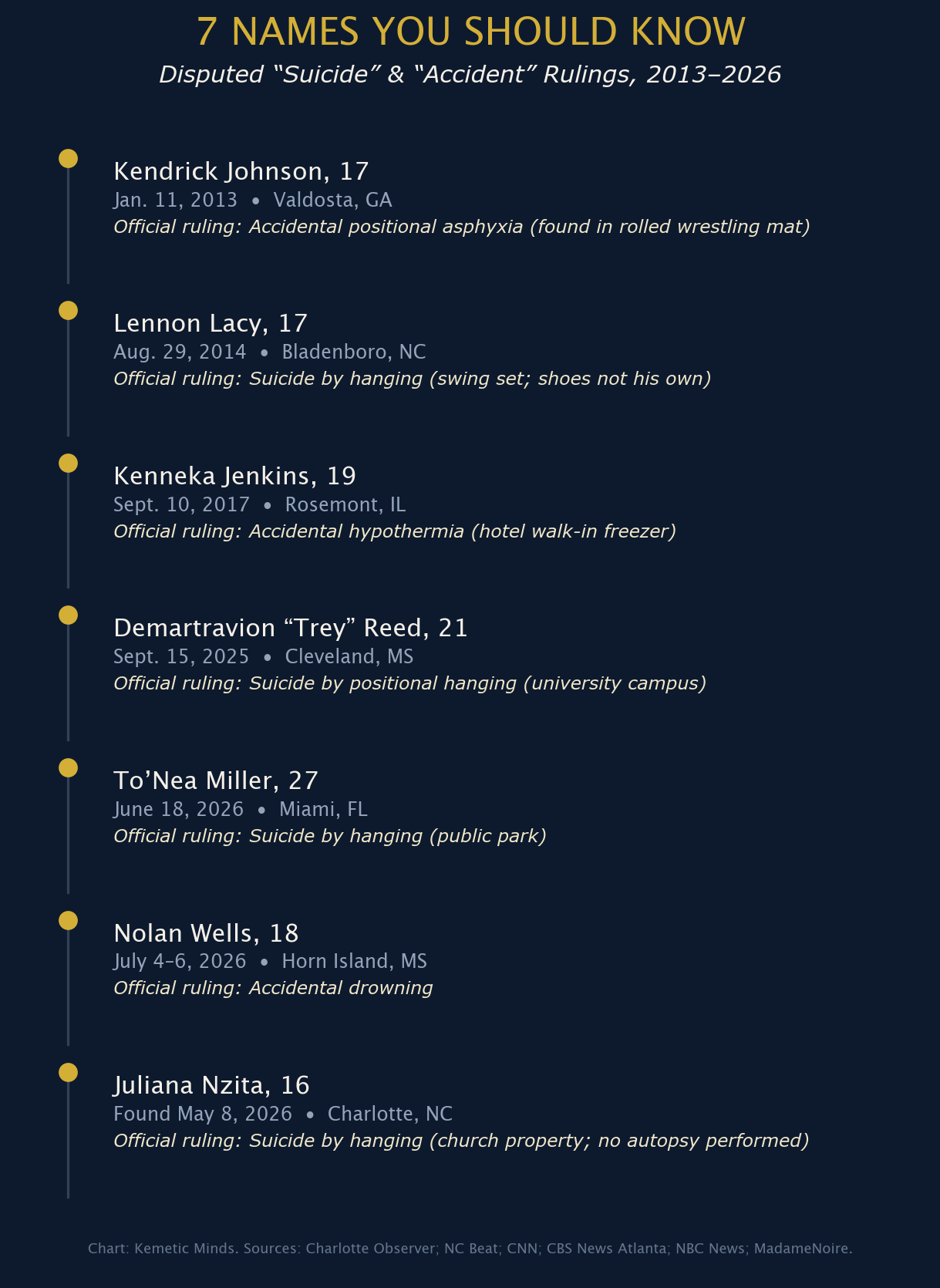
Nzita’s case is not an isolated pattern — it’s the latest entry in a recurring one. Here are six other cases from the past thirteen years where a Black person’s death was officially closed as suicide or accident, and family, community members, or civil rights attorneys pushed back on the finding[4].
Kendrick Johnson, 17
Jan. 11, 2013 · Valdosta, GA
Official ruling: Accidental positional asphyxia (found in rolled wrestling mat)
Lennon Lacy, 17
Aug. 29, 2014 · Bladenboro, NC
Official ruling: Suicide by hanging (swing set; shoes not his own)
Kenneka Jenkins, 19
Sept. 10, 2017 · Rosemont, IL
Official ruling: Accidental hypothermia (hotel walk-in freezer)
Demartravion “Trey” Reed, 21
Sept. 15, 2025 · Cleveland, MS
Official ruling: Suicide by positional hanging (university campus)
To’Nea Miller, 27
June 18, 2026 · Miami, FL
Official ruling: Suicide by hanging (public park)
Nolan Wells, 18
July 4–6, 2026 · Horn Island, MS
Official ruling: Accidental drowning
Juliana Nzita, 16
Found May 8, 2026 · Charlotte, NC
Official ruling: Suicide by hanging (church property; no autopsy performed)
What the Data Actually Shows
None of this means every disputed ruling above is wrong — medical examiners and independent reviews have upheld several of them, including Lennon Lacy’s, after FBI investigation[5]. But the skepticism driving families to demand second autopsies has a real, separate evidentiary basis: peer-reviewed research has found that Black youth suicide rates rose faster than any other demographic group over the past two decades, and that suicide misclassification is measurably higher among Black adolescents than white ones[6]. The rate for Black youth overall roughly doubled between 2001 and 2020, and the 15–19 age band specifically more than tripled between 2007 and 2017[7][6]. That means two things can be true simultaneously: suicide among Black youth is a genuine and worsening public health crisis in its own right, and a documented tendency to misclassify or under-investigate those same deaths gives families legitimate grounds to ask for a second look rather than accept the first ruling.
Figure 1
Black Youth Suicide Rate, 2001–2021 (per 100,000)
Drag to rotate, scroll to zoom. The 15–19 band is interpolated within its sourced 2007–2017 window and held flat outside it; see caption.
Chart: Kemetic Minds. Surface interpolated between published data points (not annual CDC figures). Sources: Meza, Patel, & Bath (2022), Focus; Zhou et al. (2025), Suicide and Life-Threatening Behavior, citing CDC/NCHS data.
The Infographic
We built a standalone, downloadable version of the timeline above — save it, print it, or share it directly.
Figure 2
7 Names You Should Know: Disputed Rulings, 2013–2026

⬇ Download this infographic (PNG)
Safety Tips: Protecting Yourself and Your Family
- Carry a body-worn or phone-clip camera during any tense encounter, search effort, or police interaction. Inexpensive personal body cams (or simply starting your phone’s video and narrating aloud what’s happening) create an independent record that can’t later be disputed or “lost” the way official body-cam footage sometimes is.
- Set up a silent emergency button before you need it. iPhone’s Emergency SOS (five clicks of the side button) and Android’s Emergency SOS/crisis alert both silently share your location and alert contacts without you having to speak. Wearable panic-button apps and devices (Noonlight, React Mobile, Invisawear-style discreet wearables) do the same and are worth setting up for teens and vulnerable family members specifically.
- Know how to formally request 911 audio, body-cam footage, and case files. These are public records in most states, but agencies can slow-walk requests for months. File the request in writing immediately, keep a paper trail of every follow-up, and loop in a civil rights attorney early if the response goes quiet — as the Nzita, Reed, and Wells families all did.
- Push for an autopsy at the scene, not after the fact. Once a body is released and embalmed, some forensic evidence is gone for good. If you’re a family member on scene, you can request the medical examiner perform a full autopsy before ruling anything, even if police say they don’t suspect foul play.
- Take a missing-persons report seriously from hour one. Document last known location, last contact time, phone/social media activity, and who they were last with — in writing, immediately — rather than relying on memory once panic sets in.
- Build a real support and mental-health network before a crisis, not during one. Given the documented rise in Black youth suicide, know your local crisis resources and the 988 Lifeline in advance — prevention and preparedness are not contradictory goals.
Kemetic Minds Analysis
The honest, uncomfortable read is that Juliana Nzita’s family is asking for the same basic thing every family on this timeline asked for: a real investigation before a final ruling, not instead of one. That’s not an accusation against every medical examiner or police department involved — several of these rulings have been independently upheld. It’s a request that the process work the same way regardless of who the victim is, given a documented, peer-reviewed record showing Black adolescent deaths get misclassified at higher rates than white adolescents’ do. An autopsy performed before a ruling, not contingent on police already suspecting a crime, costs little and forecloses none of these questions later. The families on this list didn’t create that gap in the process. They’re the ones left to fill it themselves, one independent autopsy and one records request at a time.
References
- 988 Suicide & Crisis Lifeline. Call or text 988, or chat at 988lifeline.org. ↩
- Associated Press, via Union-Bulletin. (2026). A Black teen found hanged near Charlotte church was a suicide, police say. Questions linger. union-bulletin.com ↩a ↩b ↩c
- Griffith, M., & McGlade, C. (2026, July 22). Investigation into the death of Juliana Nzita. charlotteobserver.com ↩
- MadameNoire. (2026). Nolan Wells isn’t the first — 10 young Black lives lost that left families fighting for answers. madamenoire.com ↩
- NBC News. (2014, December). FBI joins probe of hanging death of North Carolina teen, Lennon Lacy. nbcnews.com ↩
- Meza, J. I., Patel, K., & Bath, E. (2022). Black youth suicide crisis: Prevalence rates, review of risk and protective factors, and current evidence-based practices. Focus, 20(2), 197–203. https://doi.org/10.1176/appi.focus.20210034 ↩a ↩b
- Zhou, et al. (2025). Temporal trends in correlates for suicidal thoughts and behaviors among Black high school students in the United States, 1991–2021. Suicide and Life-Threatening Behavior. https://doi.org/10.1111/sltb.70028 ↩
Methodology: Case details are drawn from the Charlotte Observer’s original investigation and confirmed via NC Beat, the Associated Press, NBC News, CNN, CBS News Atlanta, and MadameNoire. Suicide-rate figures are from peer-reviewed sources (Meza, Patel, & Bath, 2022; Zhou et al., 2025) citing CDC/NCHS mortality data; the 3D surface interpolates between the specific published data points cited in each source’s sourced window and is not itself an annual CDC series. No figures were estimated or sourced from Wikipedia.
📱 Stay Connected