
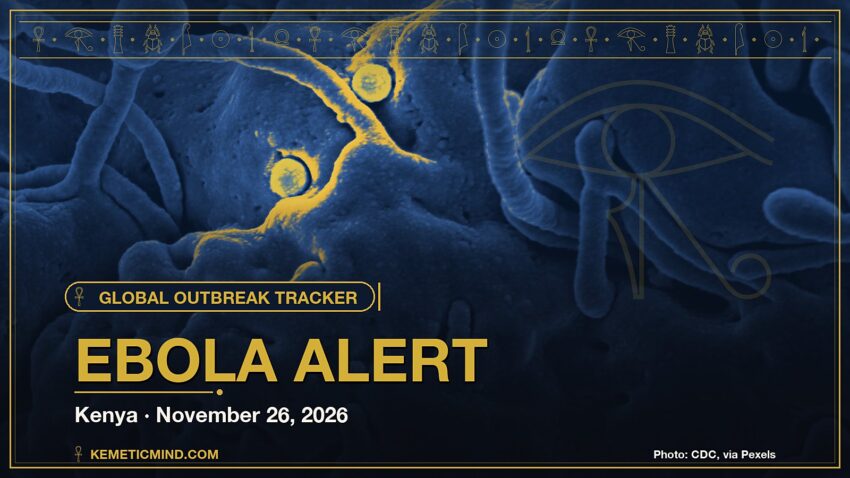
Global Outbreak Tracker · Kenya · Published November 26, 2026, 1:38 AM CST
The humanitarian organisation disclosed this in an update shared on its social media, noting that the country had 28 days left to complete the countdown towards an Ebola-free declaration.[1]
Key Facts
- Disease: Ebola
- Where: Kenya
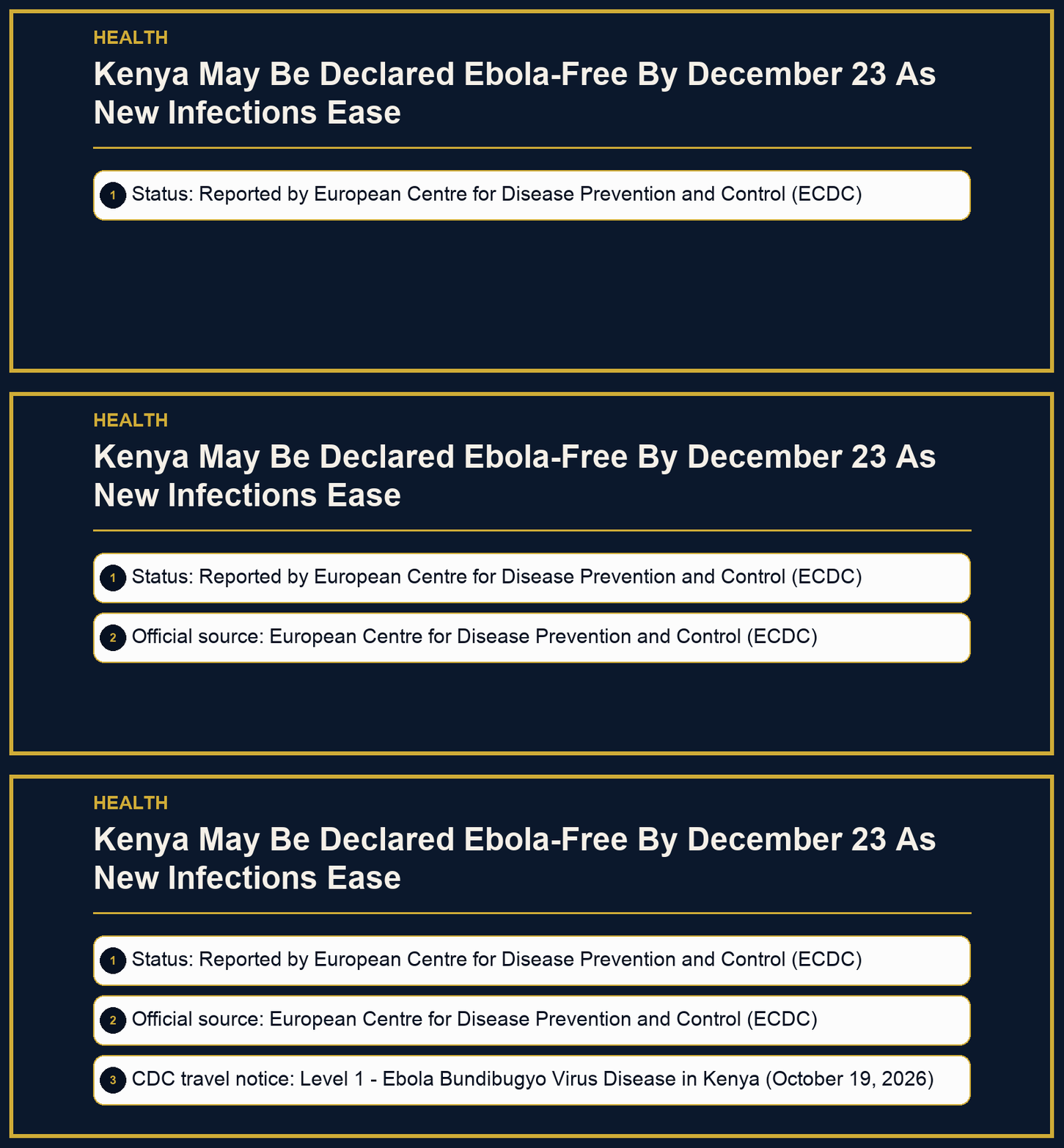
- Status: Reported by European Centre for Disease Prevention and Control (ECDC)[2]
- Outlets reporting: 3
- Official source: European Centre for Disease Prevention and Control (ECDC)
- CDC travel notice: Level 1 – Ebola Bundibugyo Virus Disease in Kenya (October 19, 2026)
The Threat
Kenya could be declared free of Ebola on December 23, 2026, if no new infections are recorded during the ongoing 42-day monitoring period, the Kenya Red Cross Society has said.[1]
The countdown began on November 12 following the discharge of the last patient receiving treatment for the disease and the release of the final group of contacts from monitoring.[1]
The Kenya Red Cross said it was working with the Ministry of Health across 20 counties to strengthen disease surveillance, screen travellers and raise public awareness about Ebola. It stated, “If no new case is reported, Kenya can be declared Ebola-free in 28 days.”[1]
European Centre for Disease Prevention and Control (ECDC) says: Cases were also reported in Kenya and Nigeria in October 2026 and have been reported in Uganda, where the outbreak has ended. As of 17 November 2026, the Democratic Republic of the Congo (DRC), where community transmission is ongoing, has reported a total of 11 504 confirmed cases, including 5 630 related deaths (from data up until 16 November).[2]
Transmission Method
What the reports say about exposure and spread: The ministry also said there was no evidence of community transmission, adding that all confirmed infections were linked to a single cluster.[1]
How Ebola spreads, according to the World Health Organization: Fruit bats are thought to be Ebola’s natural hosts. The virus reaches people through close contact with the blood, secretions, organs or other body fluids of infected animals, then spreads between people through direct contact with the body fluids of the sick. People cannot pass it on before they have symptoms. Health workers without strict infection control, and burials that involve touching the body, have often spread it.[3]
Affected Regions
Places named in the reports: Kenya, Democratic Republic of the Congo, Nigeria, Uganda, Germany, France, United Kingdom.
- The update follows progress reported by the Ministry of Health, which confirmed that all 135 people identified as contacts linked to the Ebola cases had been traced and monitored.[1]
- According to reports, Kenya achieved 100 per cent contact tracing coverage, exceeding the global benchmark of 85 per cent.[1]
- The final group of contacts completed the mandatory monitoring period and was released on November 11, while no new cases had been reported since October 19.[1]
- Since the beginning of the outbreak, eight provinces have been affected: Ituri, Nord-Kivu, Sud-Kivu, Tshopo, Haut-Uélé, Bas-Uélé, Sud Ubangi and Nord Ubangi.[2]
- Since the beginning of the outbreak, excluding cases reported from DRC and those medically evacuated to Europe, 20 cases have been reported in Uganda, nine in Kenya and one in Nigeria (medically evacuated to Switzerland).[2]
Holistic & Immune Defense Outlook
There is no herb, supplement or diet that has been shown to prevent or cure Ebola. Early intensive supportive care, including rehydration and treating symptoms, improves survival. Approved vaccines (such as Ervebo) and antibody treatments exist only for Ebola virus disease. There is no approved vaccine or treatment for Sudan or Bundibugyo virus disease; candidates are being tested. If you have symptoms after a possible exposure, the most important step is to see a clinician quickly and tell them where you have been.
The World Health Organization’s protective steps for this disease:
- Avoid close contact with sick people and with their blood and body fluids.
- Choose a safe and dignified burial; do not touch the body of someone who died of Ebola.
- Avoid contact with wild animals found sick or dead, such as fruit bats and monkeys.
What a whole-body approach can do is keep your baseline strong, so your body is better able to respond when it meets any infection. The basics have the best evidence behind them: steady sleep, a diet rich in vegetables, fruit, beans and whole grains, enough water, regular movement, and keeping routine vaccinations current.
The healers of Kemet left one of the oldest medical texts in the world, the Ebers Papyrus, written around 1550 BCE. Its lesson still holds: watch the body closely, and act early.
How 3 Outlets Are Reporting It
- Kenya government breached constitution in building US-backed Ebola quarantine site, court says (CNBC Africa)
- Kenya government breached constitution in building US-backed Ebola quarantine site, court says (Reuters)
- Kenya May Be Declared Ebola-Free By December 23 As New Infections Ease (Sahara Reporters)
References
- Sahara Reporters. Kenya May Be Declared Ebola-Free By December 23 As New Infections Ease.
- European Centre for Disease Prevention and Control (ECDC). Ebola disease: Multi-country outbreak 2026.
- World Health Organization. Ebola fact sheet.
Investigative methodology: story details come from the cited event report. Disease background comes from the World Health Organization page cited beside it. We publish a new update only when an official assessment changes and the sourcing, writing and fact checks pass.

Kemetic Minds Editorial Desk
Verified NewsroomPrimary-sourced investigative intelligence on civil rights, voting rights, federal policy, and consumer protection. Sourced from primary legal filings, government statistics, and direct field reporting.