
Consumer Rights · Scam Alert · November 25, 2026, 5:10 PM CST
Key Facts
- Wthitv issued a new alert: Parke County sheriff’s office warns of scam targeting bank customers
- Primary delivery channel: Phone call
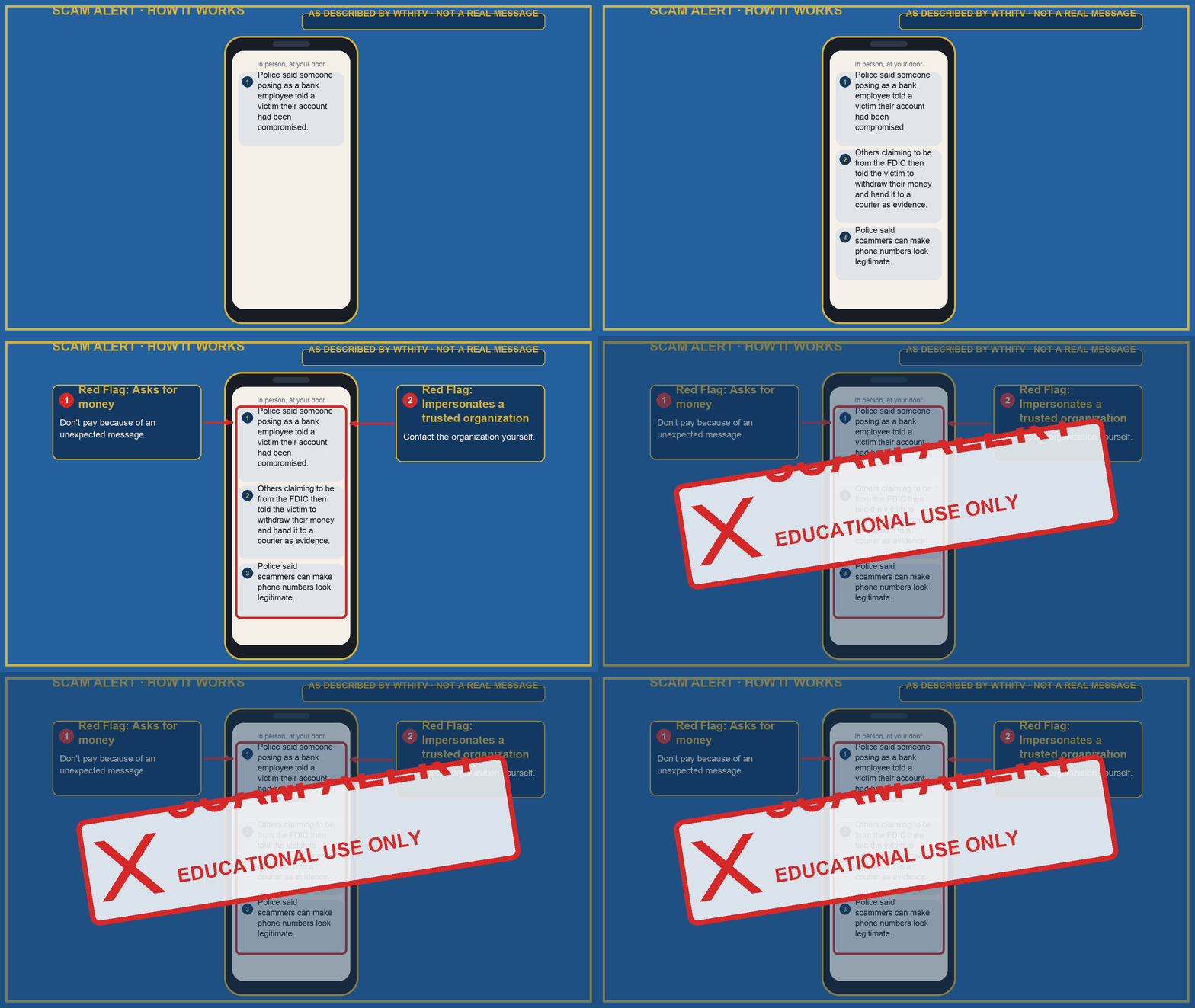
- How it reaches victims: In person, at your door.
- Tactics the source describes: Asks for money; impersonates a trusted organization.
HIGH THREAT VECTOR
Report to Federal Trade Commission (FTC) →
Parke County sheriff’s office warns of scam targeting bank customers.
Callers pose as bank employees and FDIC members.
PARKE COUNTY, Ind. (WTHI) – The Parke County Sheriff’s Office is warning about a scam targeting bank customers.[1]
Where It Happened

Map data: OpenStreetMap contributors. Street photo (2006): Chris Light, Wikimedia Commons, CC BY-SA 3.0.
What the Scam Looks Like
County Records Office(202) 555-0142 · caller ID shows a trusted nameIncoming call · live transcript
1Spoofed caller ID 2Borrowed identity
3False urgency
4Their own phone number 5Moves you off the platform
6Payment or fee
Red Flag Breakdown
Each numbered badge matches one item below. “Source tactic” means the cited report describes that tactic, not necessarily the exact words shown. “Illustrative detail” means the report does not confirm that feature occurred in this case.
- Spoofed caller ID. Shown in the simulation:
You missed a required court appearance and a warrant has been issued.
. Caller ID can be faked to display any name or number.Illustrative detail - Borrowed identity. Shown in the simulation:
You missed a required court appearance and a warrant has been issued.
. The sender uses the name of an organization you may trust. Anyone can print or type a name; it proves nothing about who sent it.Source tactic: Wthitv - False urgency. Shown in the simulation:
You must resolve this today to avoid arrest.
. A deadline, a threat or a countdown is there to stop you from checking. Real organizations give you time and put it in writing.Illustrative detail - Their own phone number. Shown in the simulation:
Call this office to arrange payment.
. The only way offered to ‘confirm’ is a number the message supplies. Look the organization up yourself instead.Illustrative detail - Moves you off the platform. Shown in the simulation:
Call this office to arrange payment.
. Pushing you to another app, number or link takes the conversation away from anything that could flag it.Illustrative detail - Payment or fee. Shown in the simulation:
We will need a payment by gift card, wire or app.
. An unexpected fee, especially by gift card, wire, crypto or a payment app, is the goal of most of these scams.Source tactic: Wthitv
How to Protect Yourself
- Do not send money because of an unexpected call, text, or email. Hang up and contact the agency or person yourself using a number you look up independently.
- Contact the organization directly using a phone number or website you look up yourself, not one provided in the message.
- Verify any unexpected contact through a phone number or website you already know is real — never one provided in an unsolicited message.
- Never send funds via gift card, wire transfer, cryptocurrency, or peer-to-peer payment apps to resolve an unexpected demand.
How to Verify This Yourself
Read the original advisory and documentation directly at Wthitv. Official bulletins from Wthitv serve as the primary source for the alert details above. To verify ongoing fraud trends or report suspicious correspondence targeting your household, visit ReportFraud.ftc.gov or submit an incident report directly to the FBI Internet Crime Complaint Center (IC3).
References
Background and official records on this topic are also available from FBI Internet Crime Complaint Center (IC3)[2], Federal Trade Commission[3].
- Wthitv. Parke County sheriff’s office warns of scam targeting bank customers. ↩
- FBI Internet Crime Complaint Center (IC3). Internet Crime and Phishing Alerts. Primary (official source) ↩
- Federal Trade Commission. FTC Consumer Scam and Fraud Guidance. Primary (official source) ↩
Investigative methodology: this update was produced by scripts/scam_monitor.py from a real Wthitv alert — not a language model. The reported facts above are drawn from the cited source. The labelled scam simulation is a fictional reconstruction based on the reported channel and tactic, not a screenshot or a transcription of an actual message unless its caption explicitly identifies quoted source wording. All sender identifiers and web addresses in it are synthetic and non-clickable. Protection tips come from fixed rules.

Kemetic Minds Editorial Desk
Verified NewsroomPrimary-sourced investigative intelligence on civil rights, voting rights, federal policy, and consumer protection. Sourced from primary legal filings, government statistics, and direct field reporting.