
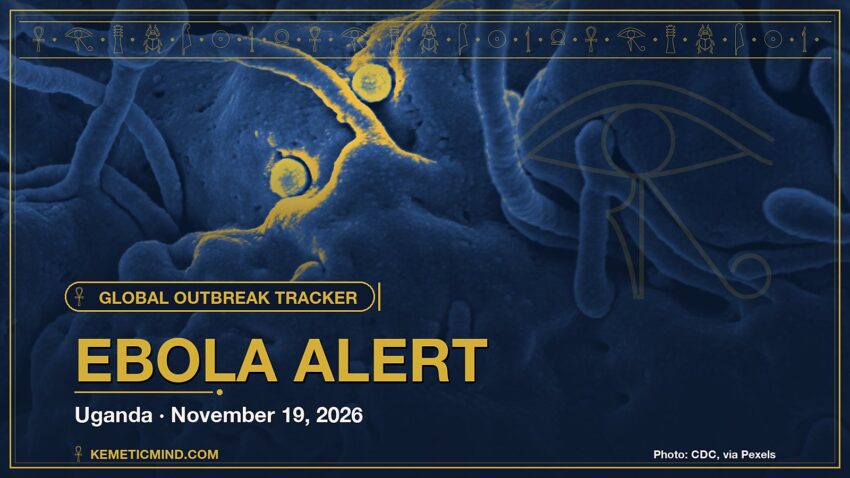
Global Outbreak Tracker · Uganda · Published November 19, 2026, 12:16 PM CST
The new measures impose sanctions on defiant Airlines and prohibit the movement of students from the DRC into Uganda.[1]
Key Facts
- Disease: Ebola
- Where: Uganda
- Status: Reported by European Centre for Disease Prevention and Control (ECDC)[2]
- Outlets reporting: 4
- Official source: European Centre for Disease Prevention and Control (ECDC)
The Threat
The government has issued tough measures, including imposing sanctions on Airlines and other transport operators found knowingly carrying unauthorised or improperly documented travellers and prohibiting the movement of day scholars from the Democratic Republic of Congo into Uganda.[1]
‘’Airlines and other operators found knowingly carrying unauthorised or improperly documented travellers will be sanctioned.’’ Ministry of Health Permanent Secretary, Dr Diana Atwine, said on Thursday.[1]
This applies to both arriving and departing passengers.[1]
European Centre for Disease Prevention and Control (ECDC) says: Key facts. – As of 15 November 2026, the Democratic Republic of the Congo (DRC), where community transmission is ongoing, has reported a total of 11 376 confirmed cases, including 5 568 related deaths (from data up until 14 November). Since the beginning of the outbreak, eight provinces have been affected: Ituri, Nord-Kivu, Sud-Kivu, Tshopo, Haut-Uélé, Bas-Uélé, Sud Ubangi and Nord Ubangi. – In Nigeria, one Ebola case was reported on 20 October 2026.[2]
Transmission Method
What the reports say about exposure and spread: The measures extend to learners, with the ministry saying the movement of day scholars from DRC into Uganda in the 34 designated high-risk districts of Uganda and vice versa has been prohibited, further directing that all boarding students with possible exposure will complete 21 days of quarantine in designated facilities before returning to school. The new measures will take immediate effect and aim at containing the spread of Ebola disease from the neighbouring Democratic Republic of Congo.[1]
How Ebola spreads, according to the World Health Organization: Fruit bats are thought to be Ebola’s natural hosts. The virus reaches people through close contact with the blood, secretions, organs or other body fluids of infected animals, then spreads between people through direct contact with the body fluids of the sick. People cannot pass it on before they have symptoms. Health workers without strict infection control, and burials that involve touching the body, have often spread it.[3]
Affected Regions
Places named in the reports: Democratic Republic of the Congo, Uganda, Kenya, Nigeria, Ethiopia, United Kingdom, United States.
- Uganda’s health minister declared the country Ebola-free on July 28 following the East African nation’s latest outbreak of the viral haemorrhagic disease that infected 20 people and killed two of them.[1]
- Of the 20 confirmed cases during the outbreak, 18 were discharged while two died from the virus, both of whom were from the Democratic Republic of Congo.[1]
- All 62 identified contacts in Nigeria completed monitoring on 11 November.[2]
- One contact remains in quarantine in Switzerland. – In Kenya, a total of nine confirmed cases, including two deaths, have been reported, all linked to the first case.[2]
What Is Not Confirmed
- The patient, a Kenyan citizen who had been residing in DRC, reportedly travelled from DRC to Kenya, via Uganda, on 3 October.[2]
- Current candidates under investigation include the ChAdOx1-BDBV candidate (developed by the University of Oxford), an mRNA-based candidate (developed by Moderna), two rVSV-based candidates (developed by IAVI and PHV), and the most recent MVA-CR19 vaccine candidate (developed by Minapharm).[2]
Holistic & Immune Defense Outlook
There is no herb, supplement or diet that has been shown to prevent or cure Ebola. Early intensive supportive care, including rehydration and treating symptoms, improves survival. Approved vaccines (such as Ervebo) and antibody treatments exist only for Ebola virus disease. There is no approved vaccine or treatment for Sudan or Bundibugyo virus disease; candidates are being tested. If you have symptoms after a possible exposure, the most important step is to see a clinician quickly and tell them where you have been.
The World Health Organization’s protective steps for this disease:
- Avoid close contact with sick people and with their blood and body fluids.
- Choose a safe and dignified burial; do not touch the body of someone who died of Ebola.
- Avoid contact with wild animals found sick or dead, such as fruit bats and monkeys.
What a whole-body approach can do is keep your baseline strong, so your body is better able to respond when it meets any infection. The basics have the best evidence behind them: steady sleep, a diet rich in vegetables, fruit, beans and whole grains, enough water, regular movement, and keeping routine vaccinations current.
The healers of Kemet left one of the oldest medical texts in the world, the Ebers Papyrus, written around 1550 BCE. Its lesson still holds: watch the body closely, and act early.
What Nilepost Reports
Uganda has suspended concerts, festivals, rallies and other mass gatherings in 34 high-risk border districts as government tightens surveillance and cross-border controls to prevent the importation of Ebola Virus Disease from the Democratic Republic of Congo (DRC). The restrictions, announced by the Ministry of Health on Thursday, November 19, take immediate effect.[4]
How 4 Outlets Are Reporting It
- Uganda announces new Ebola measures (Daily Monitor)
- Uganda Bans Mass Gatherings in Ebola-Prone Border Districts, Tightens Cross-Border Controls (Nilepost)
- Gender Dimensions Of Ebola Preparedness And Response In Uganda (ReliefWeb)
- Mortality Surveillance Detected Key Cases During Uganda 2025 Sudan Virus Outbreak (Bioengineer.org)
References
- Daily Monitor. Uganda announces new Ebola measures.
- European Centre for Disease Prevention and Control (ECDC). Ebola disease outbreak caused by Bundibugyo virus – Multi-country – 2026.
- World Health Organization. Ebola fact sheet.
- Nilepost. Uganda Bans Mass Gatherings in Ebola-Prone Border Districts, Tightens Cross-Border Controls.
Investigative methodology: story details come from the cited event report. Disease background comes from the World Health Organization page cited beside it. We publish a new update only when an official assessment changes and the sourcing, writing and fact checks pass.

Kemetic Minds Editorial Desk
Verified NewsroomPrimary-sourced investigative intelligence on civil rights, voting rights, federal policy, and consumer protection. Sourced from primary legal filings, government statistics, and direct field reporting.