
Consumer Rights · Scam Alert · November 5, 2026, 9:10 AM CST
Key Facts
- WAFF issued a new alert: 48 Scam Alert: Online shopping scams ramp up ahead of the holiday season
- HUNTSVILLE, Ala. (WAFF) – Christmas is right around the corner, but the Better Business Bureau warned scammers are already working overtime to cash in on holiday shoppers.
HIGH THREAT VECTOR
Report to Federal Trade Commission (FTC) →
48 Scam Alert: Online shopping scams ramp up ahead of the holiday season.
HUNTSVILLE, Ala. (WAFF) – Christmas is right around the corner, but the Better Business Bureau warned scammers are already working overtime to cash in on holiday shoppers.
According to data from the Better Business Bureau of North Alabama, 18 people in the region reported falling victim to online shopping scams in October alone. Officials expect those numbers to rise significantly as more consumers turn to the internet for holiday gifts.[1]
By the Numbers
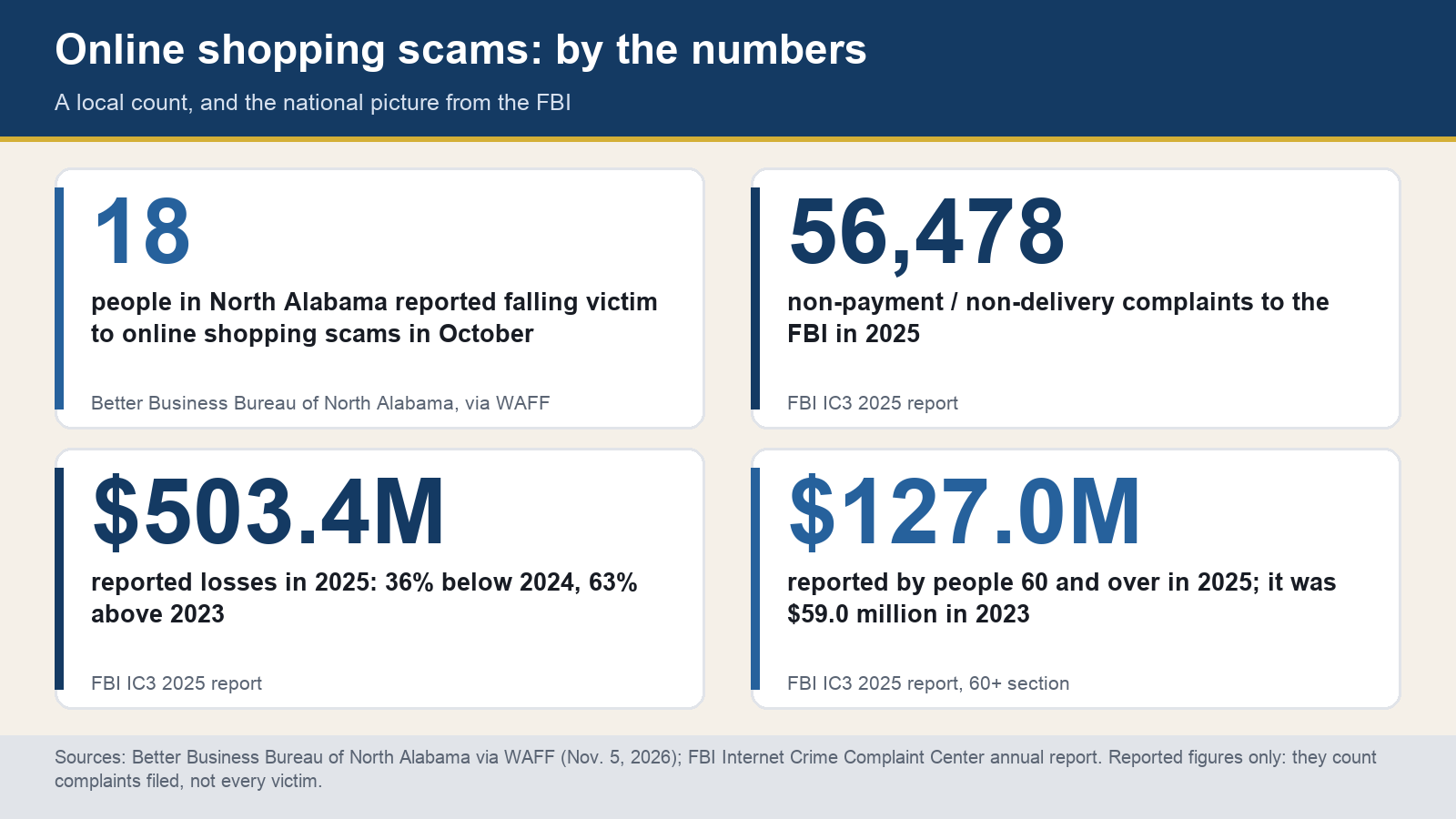
The Better Business Bureau count above covers one region and one month.[1] For a national picture, the FBI’s Internet Crime Complaint Center (IC3) tracks what it calls non-payment and non-delivery fraud: a buyer pays for goods or services and never receives them, or a seller ships and is never paid.[4]
What the FBI’s Complaint Data Shows
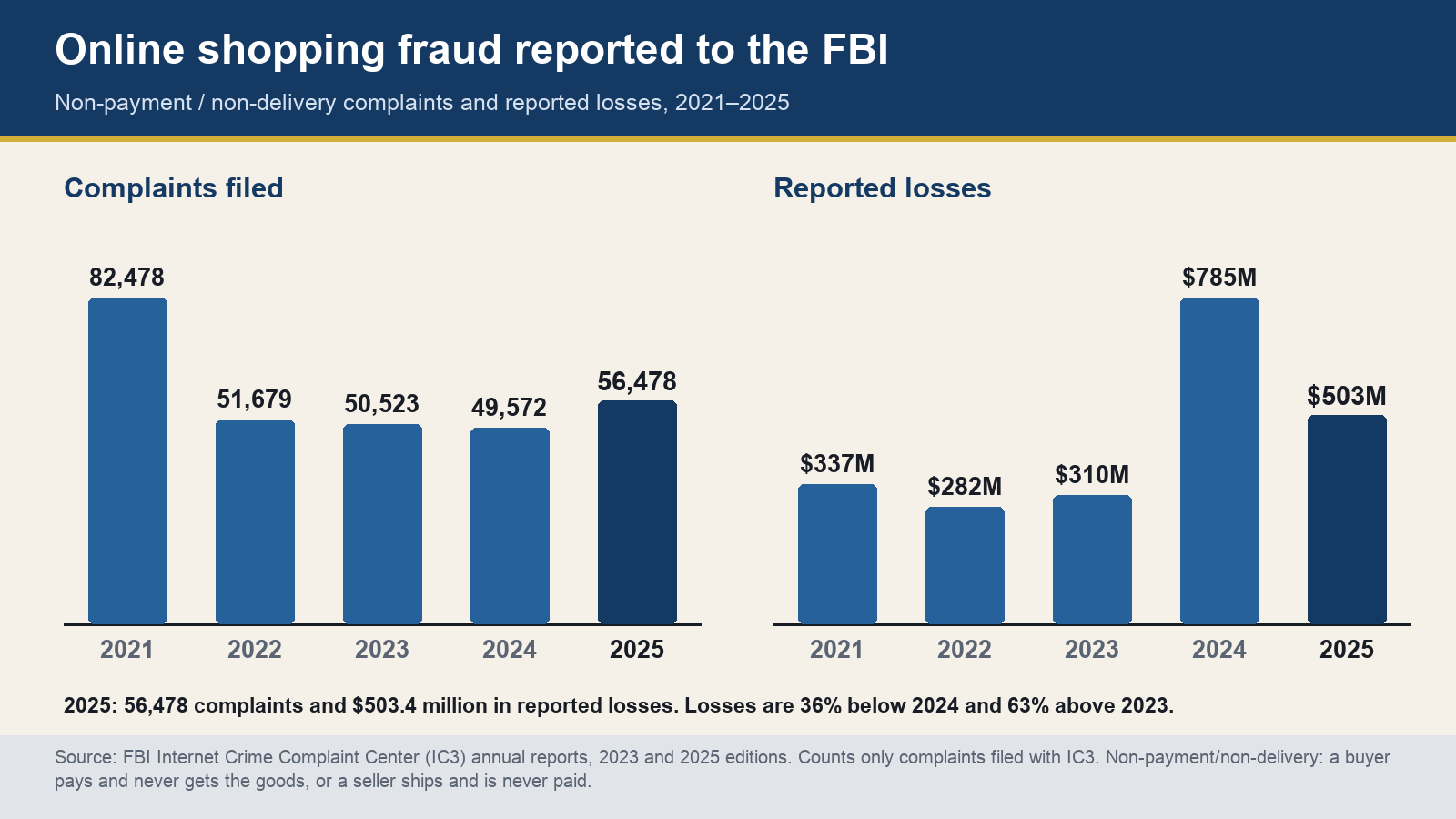
In 2025, IC3 received 56,478 such complaints, with reported losses of $503,373,587.[2] Losses were $785,436,888 in 2024 and $309,648,416 in 2023.[2] In 2021 there were 82,478 complaints and $337,493,071 in losses; in 2022, 51,679 and $281,770,073.[3]
People 60 and older filed 9,743 of the 2025 complaints and reported $127,041,813 in losses, up from $59,018,965 in 2023.[2]
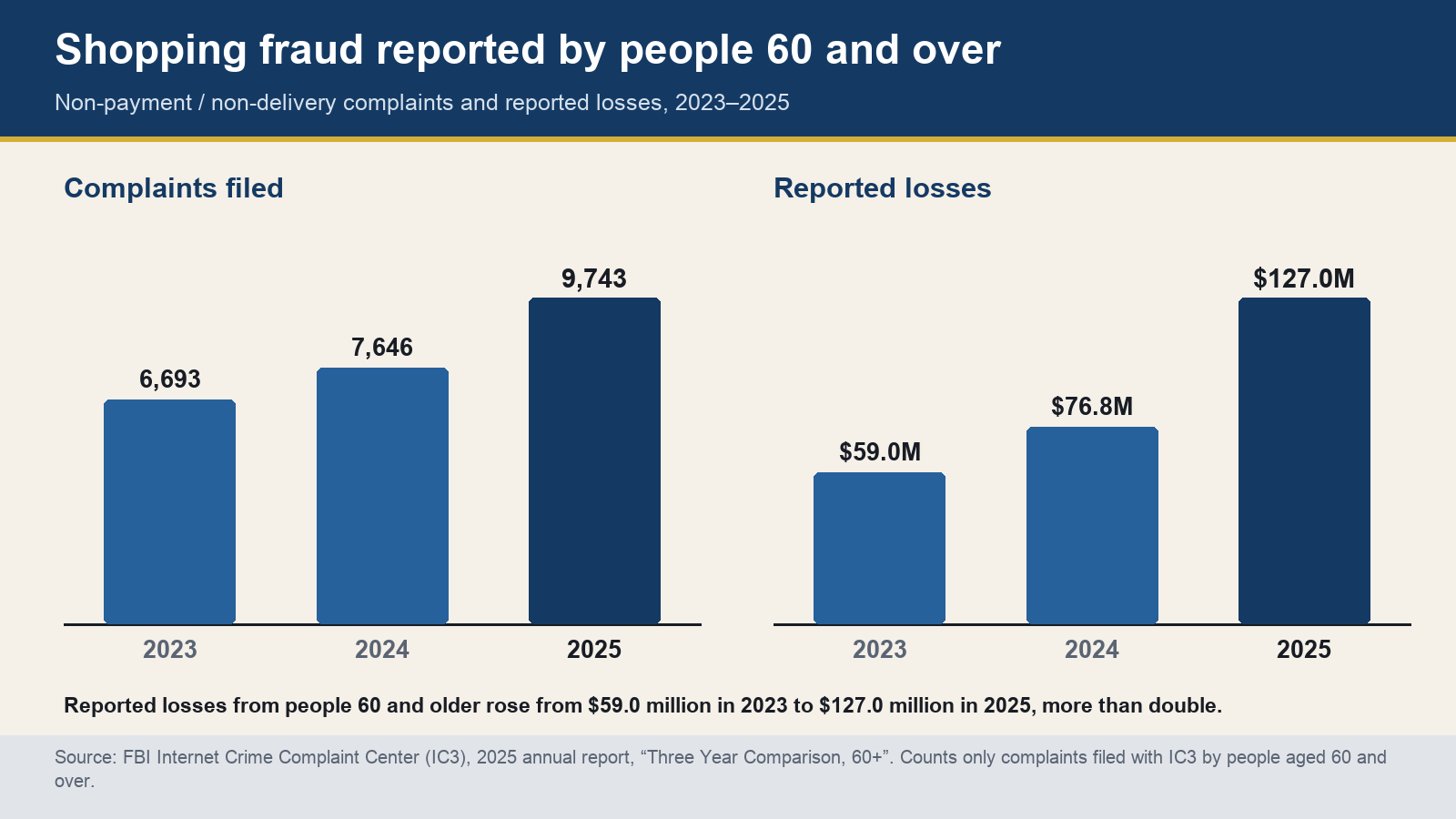
These are complaints filed with IC3. They are not a count of every victim or every dollar lost.
How a Fake-Store Scam Works
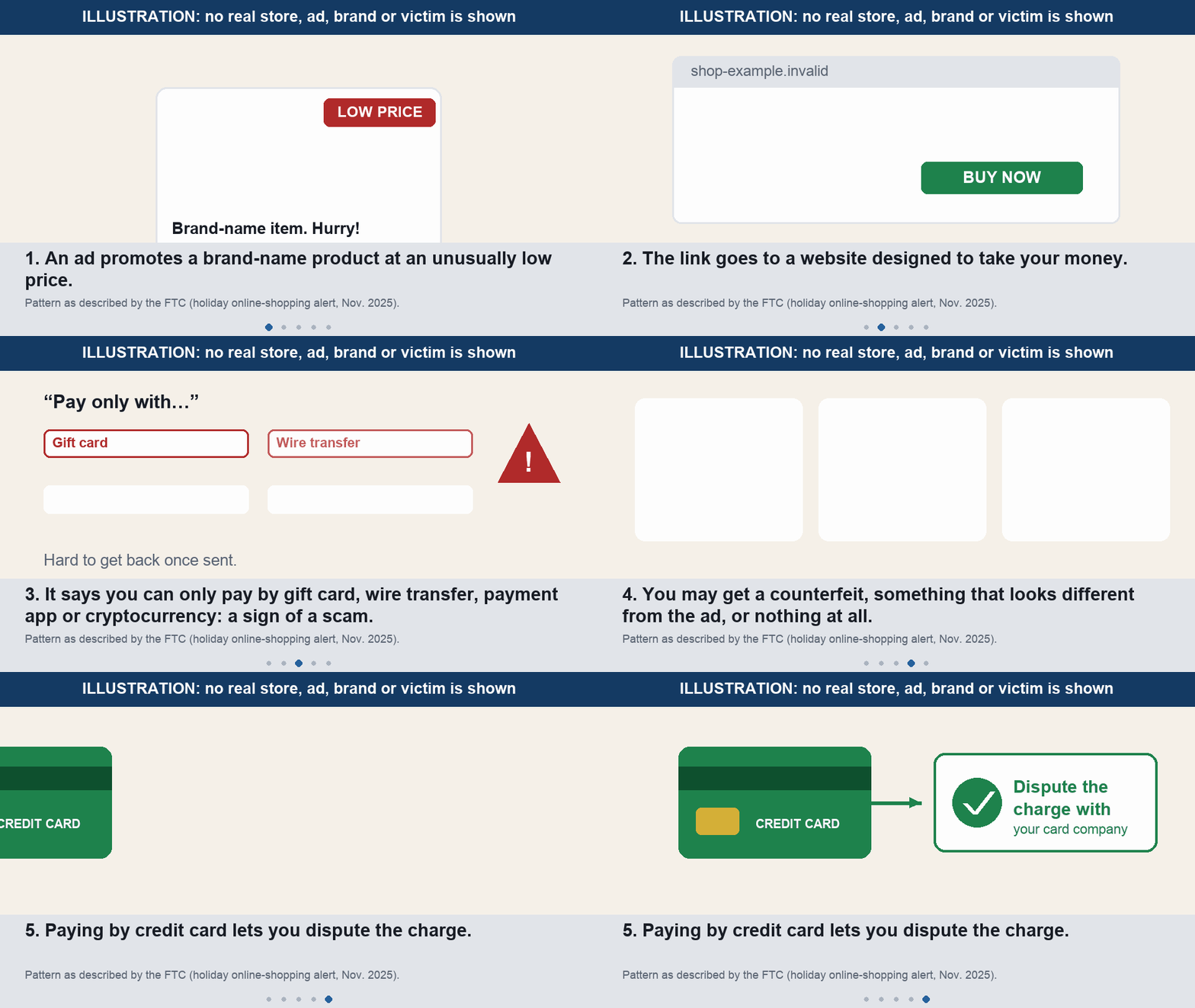
The FTC says scammers are everywhere online, especially on social media. They sometimes impersonate real companies and run ads for brand-name products at unusually low prices. A link in such an ad could lead to a website designed to take your money in exchange for a counterfeit item, something that looks completely different from the picture in the ad, or nothing at all.[5] The animation below shows that pattern. It is an illustration only: no real store, ad or victim is shown.
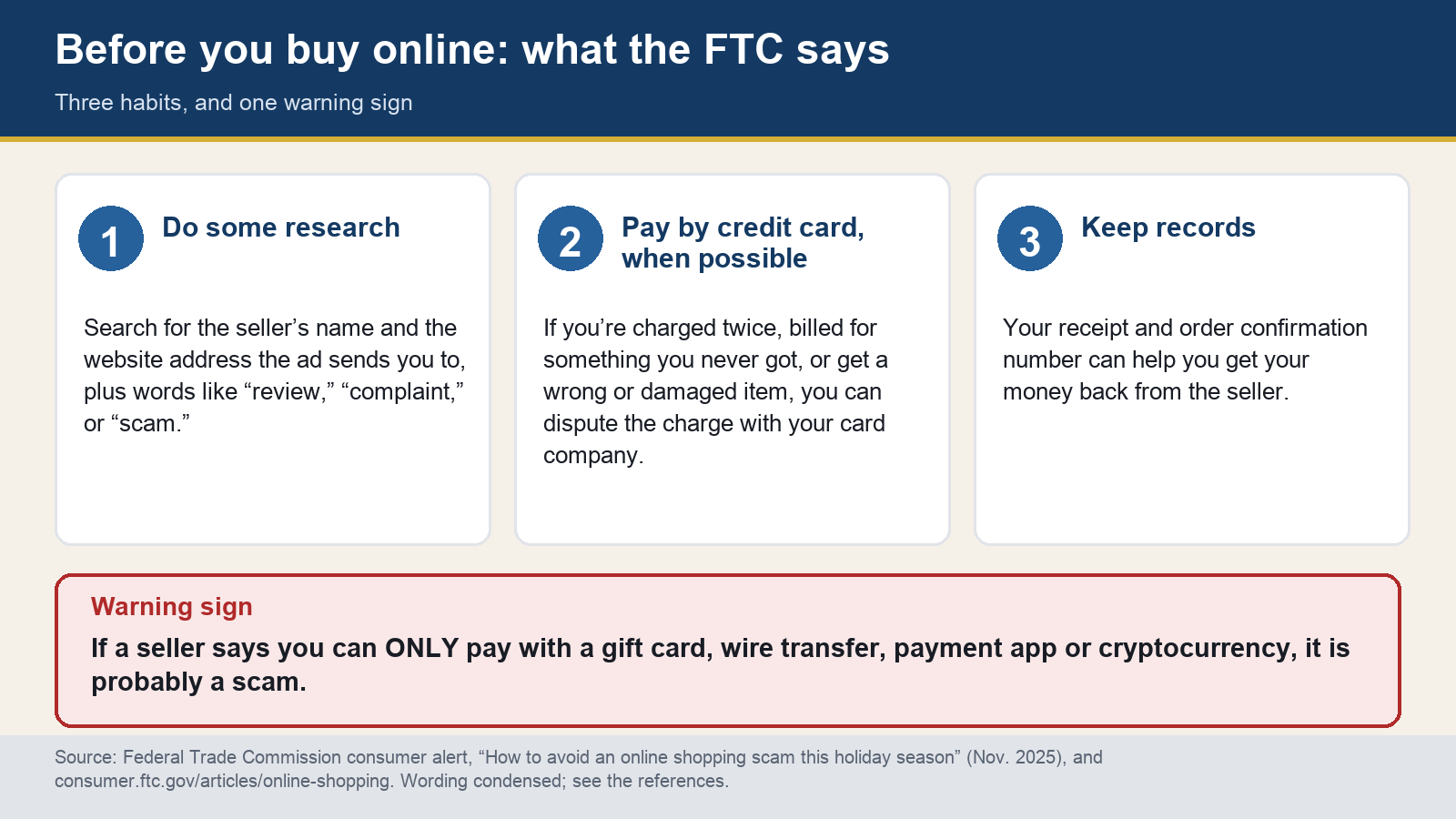
Before You Buy: What the FTC Recommends
Where It Happened
The pin marks Huntsville as named in the report, not an exact address. Map data: OpenStreetMap contributors.
How to Protect Yourself
- Verify any unexpected contact through a phone number or website you already know is real — never one the message itself provides.
- Search for the seller’s name and the website address the ad sends you to, plus words like “review,” “complaint” or “scam,” before you buy.[5]
- Pay by credit card when possible. If you are charged twice, billed for something you never got, or sent a wrong or damaged item, you can dispute the charge.[5]
- Be wary of any seller that says you can only pay with a gift card, wire transfer, payment app or cryptocurrency.[5][6]
- Report a scam to the FTC at ReportFraud.ftc.gov and to the FBI at ic3.gov.[4][5]
How to Verify This Yourself
Read the original alert directly at WAFF — that page is the primary source for everything above.
References
- WAFF. 48 Scam Alert: Online shopping scams ramp up ahead of the holiday season. ↩
- FBI Internet Crime Complaint Center. 2025 Internet Crime Report (non-payment/non-delivery: pp. 25–26; ages 60+: pp. 47–48). ↩
- FBI Internet Crime Complaint Center. 2023 Internet Crime Report (2021 and 2022 figures: pp. 22–23). ↩
- FBI. Holiday Scams (definition of non-payment and non-delivery scams). ↩
- Federal Trade Commission. How to avoid an online shopping scam this holiday season (consumer alert, November 2025). ↩
- Federal Trade Commission. Online Shopping (consumer advice). ↩
Investigative methodology: this update was produced by scripts/scam_monitor.py from a real WAFF alert — not a language model. The quoted text above is verbatim from the source; any message or description shown in the illustration is quoted or copied from the source itself (see its caption); when the source does not publish the scam’s wording, none is shown or invented. Protection tips are matched from a fixed keyword list, not generated per story. The sections from “By the Numbers” through “Before You Buy,” the charts and the added tips were assembled in an editorial pass from the FBI and FTC documents listed above; every figure is copied from them, the animation is labelled as an illustration, and the graphics were drawn with pygame.

Kemetic Minds Editorial Desk
Verified NewsroomPrimary-sourced investigative intelligence on civil rights, voting rights, federal policy, and consumer protection. Sourced from primary legal filings, government statistics, and direct field reporting.